XUYE EQUIPMENT
- Language Switching
Search the whole station
Date pits, also known as date seeds or date stones, are valuable agricultural biomass resources that can be converted into activated carbon through carbonization and activation processes. With the increasing demand for activated carbon in water treatment, air purification, industrial filtration, and environmental protection, date palm seeds offer an alternative raw material for activated carbon manufacturing.
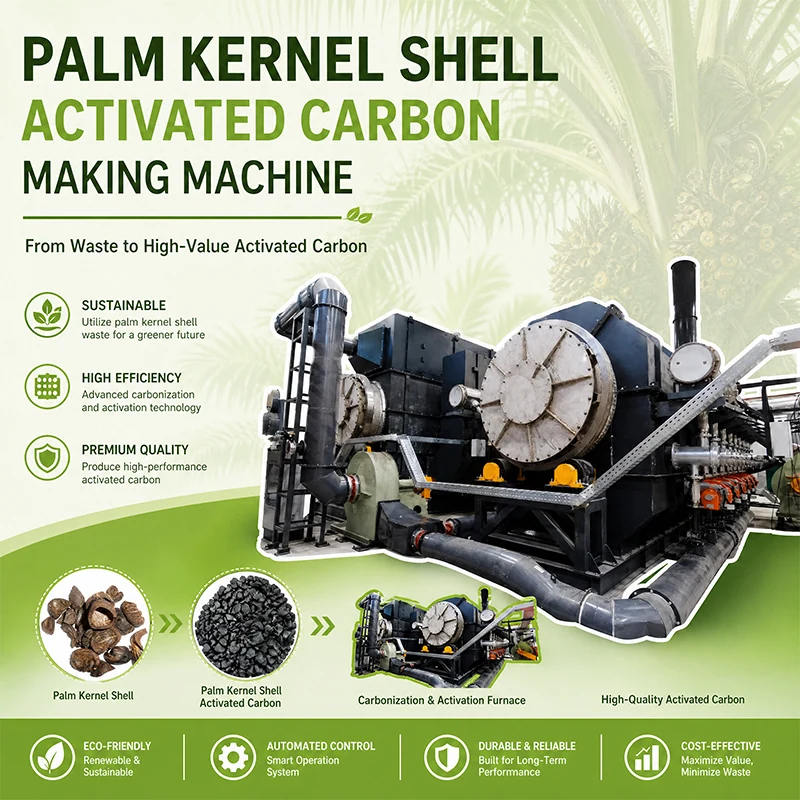
The Date Pits Activated Carbon Making Machine is designed to process date palm seeds into high-quality activated carbon through a series of thermal processing operations. The production line can include raw material drying, crushing, screening, carbonization, activation, cooling, and final product processing.
Henan Xuye Machinery provides customized activated carbon production equipment and complete processing solutions for agricultural biomass materials. Our equipment can be configured according to raw material characteristics, production capacity, activation requirements, and the desired activated carbon product specifications.
Whether you are planning to establish a date seed activated carbon manufacturing plant or expand an existing biomass carbon production facility, we can provide suitable carbonization furnaces, activation rotary kilns, and supporting equipment.
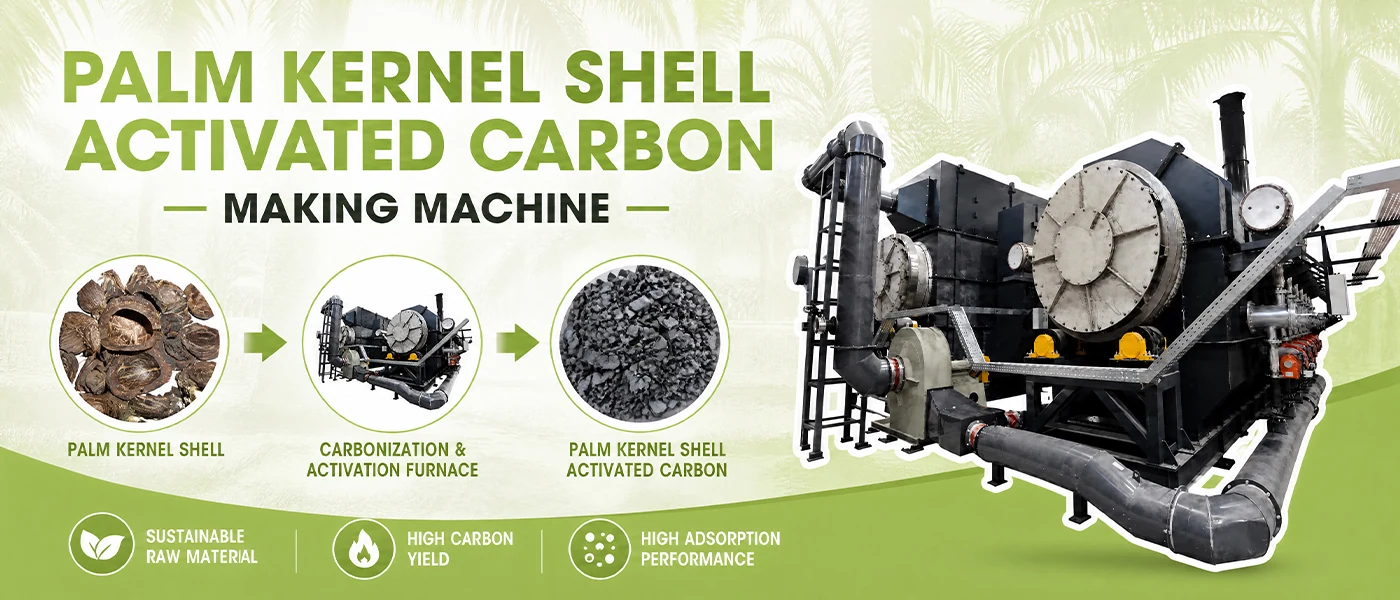
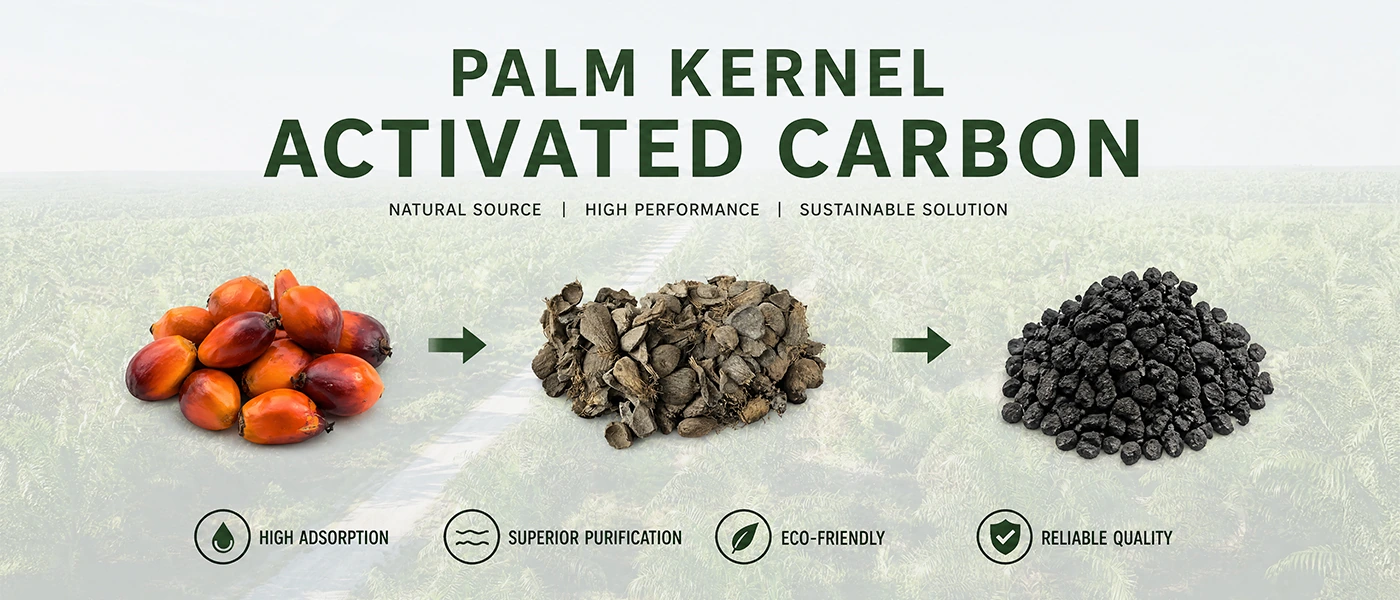
Palm kernel shells are produced during the processing of oil palm fruits. In countries with established palm oil industries, this material can be available in substantial quantities near processing facilities.
The commercial opportunity lies in converting a biomass residue into a higher-value industrial material. Activated carbon is used in water treatment, wastewater purification, gas treatment, decolorization, and other adsorption processes.
However, a successful palm kernel shell activated carbon project requires more than access to raw materials. The manufacturer must understand the relationship between feedstock quality, carbonization, activation, product specifications, and customer demand.
For businesses located near palm oil mills or palm kernel processing facilities, local shell availability may support the development of a biomass-based activated carbon operation.
A nearby raw material source can help reduce transportation requirements and simplify supply coordination. The actual benefit depends on the purchase price, moisture content, seasonal availability, storage conditions, and distance between the supplier and factory.
Before purchasing equipment, investors should estimate the annual quantity of usable palm kernel shells available to the project. They should also determine whether the raw material supply is stable enough to support the intended production schedule.
Palm kernel shells can be converted into charcoal through carbonization. Further activation develops the pore structure required for adsorption.
The commercial value of the final product depends on its performance and suitability for a specific market. Activated carbon intended for industrial wastewater treatment may have different requirements from carbon intended for gas purification or other specialized applications.
Consequently, the production line should be designed around the target product rather than selected solely according to the raw material.
A company already involved in palm oil processing, biomass trading, charcoal production, or industrial materials may consider adding activated carbon manufacturing to its existing business.
The feasibility of this expansion depends on available infrastructure, technical expertise, utility supply, environmental requirements, and market demand.
A preliminary engineering assessment can help determine whether the project should begin with a carbonization unit, a dedicated activation system, or a complete integrated production line.
A palm kernel shell activated carbon project should be planned as a connected production system. Each stage influences the next, and the performance of the complete line depends on coordination between the major equipment units.
The first stage is to establish the condition of the incoming palm kernel shells.
Important factors include moisture content, particle size distribution, contamination, ash content, and the consistency of the material supplied by different vendors.
Screening equipment can remove unsuitable particles and help establish a more consistent feed size. A dryer may be required when the raw material contains excessive moisture.
The pretreatment system should match the actual feedstock. Installing an oversized dryer or unnecessary processing equipment can increase capital expenditure without providing a corresponding benefit.
Carbonization converts the prepared shells into a carbon-rich intermediate material under oxygen-limited conditions.
The process releases volatile compounds and changes the chemical and physical structure of the original biomass. The resulting charcoal becomes the feedstock for the activation stage.
A suitable carbonization furnace should provide controlled heating, appropriate residence time, stable feeding where continuous operation is required, and safe management of the gases generated during processing.
The choice between batch and continuous carbonization depends on the intended production scale, investment budget, operating schedule, and product requirements.
Carbonized palm kernel shells do not automatically have the adsorption performance expected from finished activated carbon.
Activation is required to develop an appropriate pore structure. Physical activation using steam is a common process route for shell-based activated carbon.
During steam activation, the carbonized material reacts with steam at elevated temperatures. The reaction gradually consumes part of the carbon and develops pores.
The activation conditions must balance product performance against yield. Excessive activation may increase carbon consumption and reduce the amount of finished product obtained from the original feedstock.
An activated carbon rotary kiln can be considered for continuous processing where the design provides suitable heat transfer, material movement, gas distribution, and residence time.
Hot activated carbon must be cooled under appropriate conditions before it is exposed to routine handling and packaging operations.
The cooling equipment should match the discharge temperature, material throughput, product form, and plant layout.
Cooling design is also a safety consideration because hot carbon can oxidize when exposed to oxygen under unsuitable conditions.
After cooling, the activated carbon may require screening to obtain the specified particle size distribution.
Depending on the product, additional crushing, grading, or dedusting equipment may be required.
Granular activated carbon manufacturers generally need to control particle size and fines content. Powdered products require a different finishing arrangement and more attention to dust management.
The final product should be sampled and tested against the customer’s acceptance criteria before shipment.
The carbonization furnace is one of the main equipment decisions in a palm kernel shell activated carbon project.
Its selection affects material throughput, operating continuity, energy requirements, process control, maintenance, and the characteristics of the charcoal supplied to the activation system.
A batch furnace processes a defined quantity of material during each operating cycle.
This configuration may be suitable for smaller projects, trial production, or businesses that prefer to operate in separate batches.
The operator loads the raw material, carries out the carbonization cycle, and discharges the material after processing.
The main considerations include batch capacity, heating time, cooling time, labor requirements, and the consistency of charcoal produced between batches.
For a project targeting a stable, large daily output, the investor should compare the actual operating cycle and number of batches required with the proposed production target.
A continuous carbonization system is designed to accept feed material and discharge processed material during ongoing operation.
Depending on the equipment design, a rotary carbonization furnace can move the material through a heated chamber while controlling the process atmosphere.
Continuous equipment may be appropriate for projects requiring regular production and coordinated operation with downstream activation equipment.
However, a continuous system is not automatically the most economical choice for every project. Capital cost, feedstock consistency, maintenance capability, operating hours, and the required production volume must all be evaluated.ch may include particle size distribution, moisture content, ash content, iodine number, hardness, and other adsorption or physical properties.
Before selecting a carbonization furnace, buyers should establish:
These details help establish a more realistic equipment specification than selecting a furnace based on nominal capacity alone.
The activation system determines how the carbonized palm kernel shells are processed into the final adsorbent.
For continuous physical activation, a rotary kiln may be suitable when its thermal and mechanical design matches the required operating conditions.
The material must remain in the activation zone long enough to achieve the desired degree of pore development.
Kiln rotation speed, inclination, internal structure, feed rate, and equipment dimensions influence material movement and residence time.
These variables must be coordinated. Increasing feed rate without adjusting the process can reduce residence time and change product quality.
Activation requires controlled high-temperature operation.
Uneven heating can result in differences in activation severity between material particles. The heating arrangement and temperature measurement system should therefore be considered during equipment selection.
For steam activation, the steam supply system must provide a suitable flow under the required operating conditions.
Steam distribution should be designed for the selected kiln rather than treated as an independent auxiliary component.
The correct operating conditions depend on the raw material, carbonized feed, kiln design, and finished product requirements.
The rotary kiln should be integrated with the feeding, conveying, cooling, and finishing equipment.
The purpose of the integrated arrangement is to support stable material flow and reduce unnecessary handling between processing stages.
For a commercial plant, the complete line should be evaluated rather than comparing rotary kilns only by their dimensions or motor power.
The manufacturing cost of palm kernel shell activated carbon depends on the complete production process.
A useful cost assessment should include raw materials, utilities, labor, maintenance, environmental management, packaging, and the cost of quality control.
The cost of palm kernel shells depends on the supplier, material quality, moisture content, location, and delivery arrangement.
A low purchase price may not necessarily produce the lowest cost per tonne of finished activated carbon. Material with excessive moisture or inconsistent properties may increase drying requirements and complicate process control.
Carbonization and activation require thermal energy.
The energy requirement depends on the moisture content of the feedstock, equipment insulation, heating method, process temperature, production rate, and potential heat recovery.
Energy consumption should be calculated using the actual equipment configuration and local fuel prices.
For steam activation, the plant must account for the energy and water required to generate steam.
The steam system should be sized according to the process requirements. Poor coordination between steam supply and the activation kiln can increase operating costs or affect product quality.
Yield has a direct effect on the amount of raw material required to produce a tonne of saleable activated carbon.
Increasing activation severity may improve certain product properties while reducing yield. The economically appropriate operating point depends on the selling price and the product specification.
The level of automation, plant layout, equipment reliability, spare parts availability, and operator training all affect operating expenses.
The maintenance plan should cover the major thermal processing equipment, conveying systems, fans, burners, instruments, and other components installed in the line.
Dust collection, gas handling, exhaust treatment, and other environmental systems form part of the production cost.
These items should be included in the original project budget instead of being treated as optional additions after the plant has been installed.
| Capacity | 5-8t/d | 8-10t/d | 10-12t/d | 12-15t/d | 15-20t/d |
| Dryer model | HG-800 | HG-1000 | HG-1200 | HG-1500 | HG-1800 |
| Dryer power | 3kw | 4kw | 7.5kw | 15kw | 22kw |
| continuous carbonization furnace model | TH-1500 | TH-1500 | TH-1800 | TH-2000 | TH-2000 |
| Carbonization temperature | 600-850℃ | ||||
| Fixed carbon content after carbonization | 70-80% | ||||
| Carbonization furnace drum material | 309S/310S | 309S/310S | 309S/310S | 309S/310S | 309S/310S |
| Activation furnace model | HN-5 | HN-8 | HN-10 | HN-12 | HN-15 |
| Activation furnace power | 15kw | 22kw | 30kw | 37kw | 37kw |
| Activation furnace chamber material | QQ345+nano thermal insulation board+refractory | ||||
| Activation temperature | 850-950℃ | ||||
| Activator | Water vapor or Phosphoric acid (customized according to customer requirements, equipment design will be updated) | ||||
| Activation time | 1-2h | ||||
| Cooling machine model | GTL-1004 | GTL-1204 | GTL-1206 | GTL-1504 | GTL-1506 |
| Temperature after cooling | ≤40℃ | ||||
| Activated carbon crusher model | SGP-400 | SGP-400 | SGP-600 | SGP-800 | SGP-800 |
| Activated carbon finished product size | 4-60mesh | ||||
| Activated carbon iodine value | 800-1300mg/g | ||||
| Activated carbon specific surface area | 800-1500m²/g | ||||
| Activated carbon strength | ≥95 | ||||
| CTC | ≥60% | ||||
| Filling density | 0.45-0.55g/cm3 | ||||
| Activated carbon ash | ≤3% | ||||
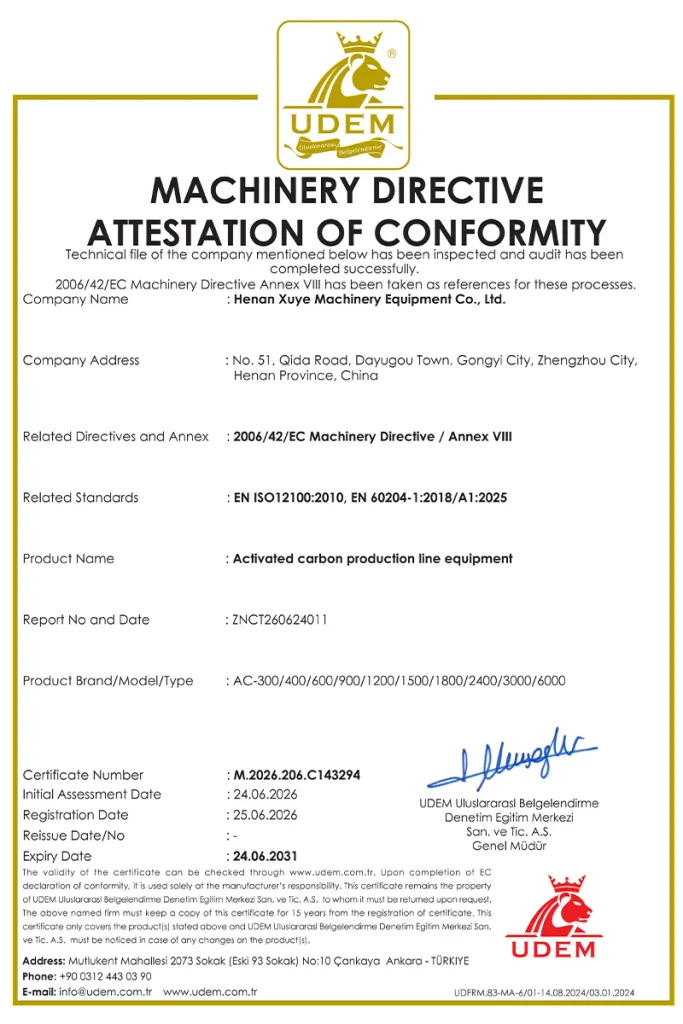
CE Certificate
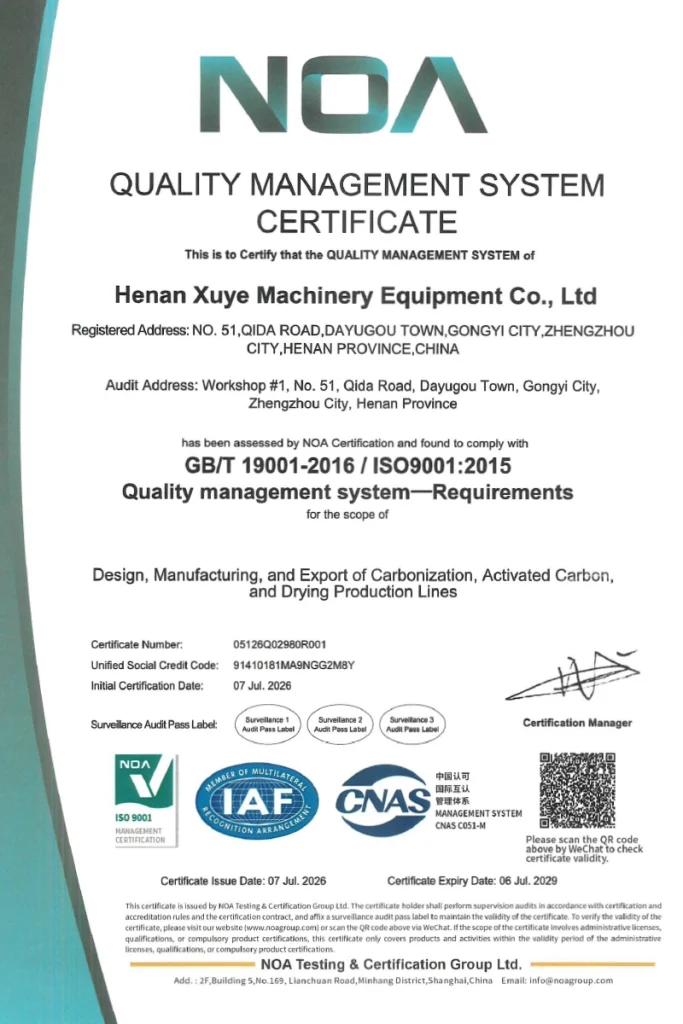
ISO Quality Management Certificate
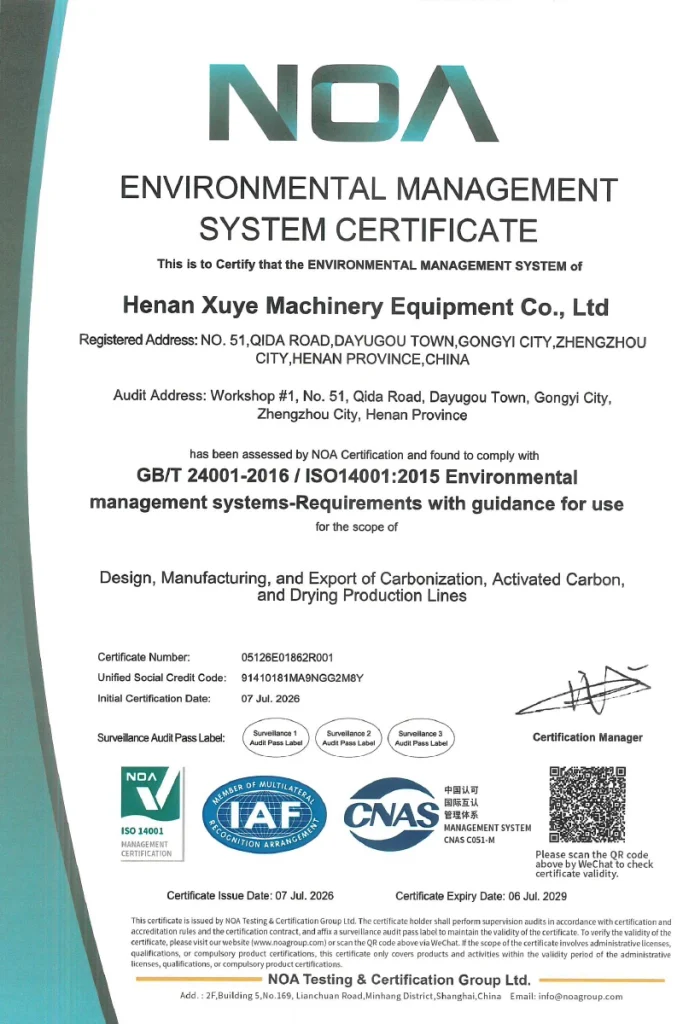
ISO Environmental Management Certificate
Frequently Asked Questions About Activated Carbon Production Lines
Common raw materials include coconut shells, coal, wood, nutshells, and other carbon-rich biomass materials. The choice of raw material depends on the desired activated carbon properties, local availability, production costs, and the intended application. Different raw materials may require different processing methods and equipment configurations.
The production capacity depends on the equipment model, raw material type, moisture content, processing method, operating temperature, and required product quality. Xu Ye Machinery can recommend a suitable equipment configuration according to the customer’s target output and project requirements. Customers should confirm whether the specified capacity refers to raw material input or finished activated carbon output.
Yes. Equipment configuration can be tailored to the raw material, target production capacity, available factory space, energy source, automation requirements, and finished product specifications. Customization may include furnace type, feeding and discharging systems, temperature control, auxiliary equipment, and environmental protection systems. A technical assessment is recommended before finalizing the production line.
Yes. Xu Ye Machinery can provide successful project cases for reference, including activated carbon production line installations and equipment commissioning projects in different countries. These cases help customers better understand our equipment, production processes, and project implementation experience. Please contact us to learn more about relevant projects and find a suitable solution for your production needs.
A carbonization furnace converts raw materials into carbon-rich char through heating under oxygen-limited conditions. An activation furnace further develops the pore structure of the carbonized material to improve its adsorption properties. Carbonization and activation are two different stages of activated carbon production, and each requires appropriate process conditions and equipment.
Energy consumption varies according to the equipment design, production capacity, raw material moisture, process temperature, heat recovery system, and operating conditions. A reliable energy estimate should be based on the proposed equipment configuration and process requirements. Customers should evaluate fuel or electricity consumption together with auxiliary equipment, exhaust-gas treatment, and other operating costs.
The installation and commissioning period depends on the production line size, equipment configuration, site preparation, foundation work, utility connections, and local operating conditions. Before installation, customers should prepare the required space, foundations, power supply, fuel supply, and environmental protection facilities according to the technical drawings. The installation schedule should be confirmed with the equipment supplier for each project.
Xu Ye Machinery can discuss technical support and after-sales service arrangements according to the project requirements and sales agreement. Customers should confirm the scope of installation guidance, commissioning support, operator training, spare parts supply, warranty coverage, and remote technical assistance before placing an order.