 ОБОРУДОВАНИЕ XUYE


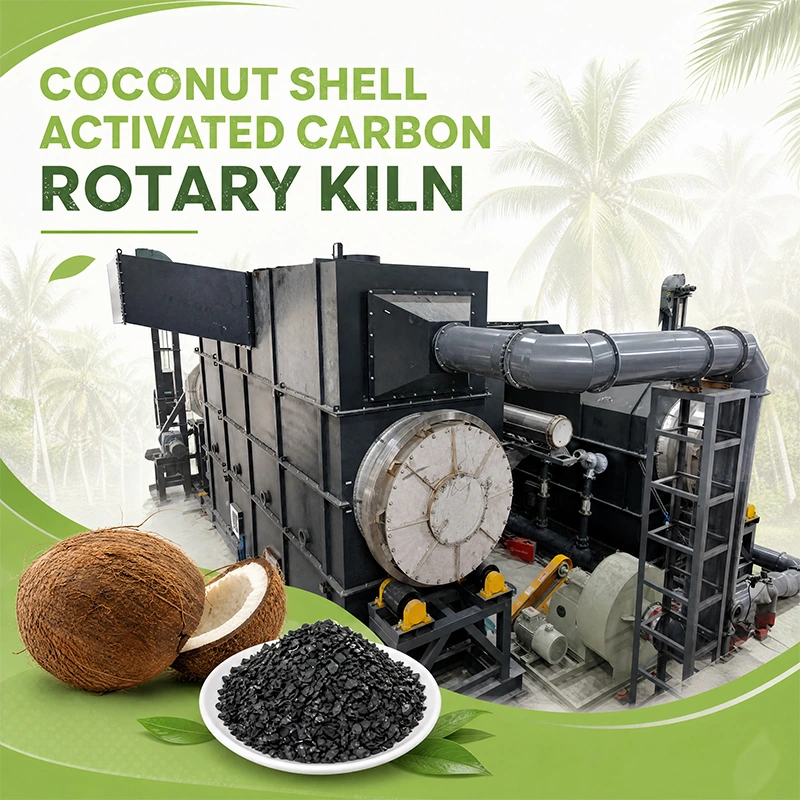
Coconut shells activated carbon rotary kiln
Сайт Coconut Shell Activated Carbon Rotary Kiln is an industrial thermal processing machine designed for the carbonization and activation of coconut shell-based carbon materials. It is an important piece of equipment for manufacturers producing granular or powdered activated carbon from coconut shells.
Coconut shells are widely used as raw materials for activated carbon because their carbon-rich structure can be processed to develop a porous material with adsorption properties. Through appropriate carbonization and activation processes, coconut shell charcoal can be converted into activated carbon for water treatment, air purification, industrial gas treatment, gold recovery, and other applications.
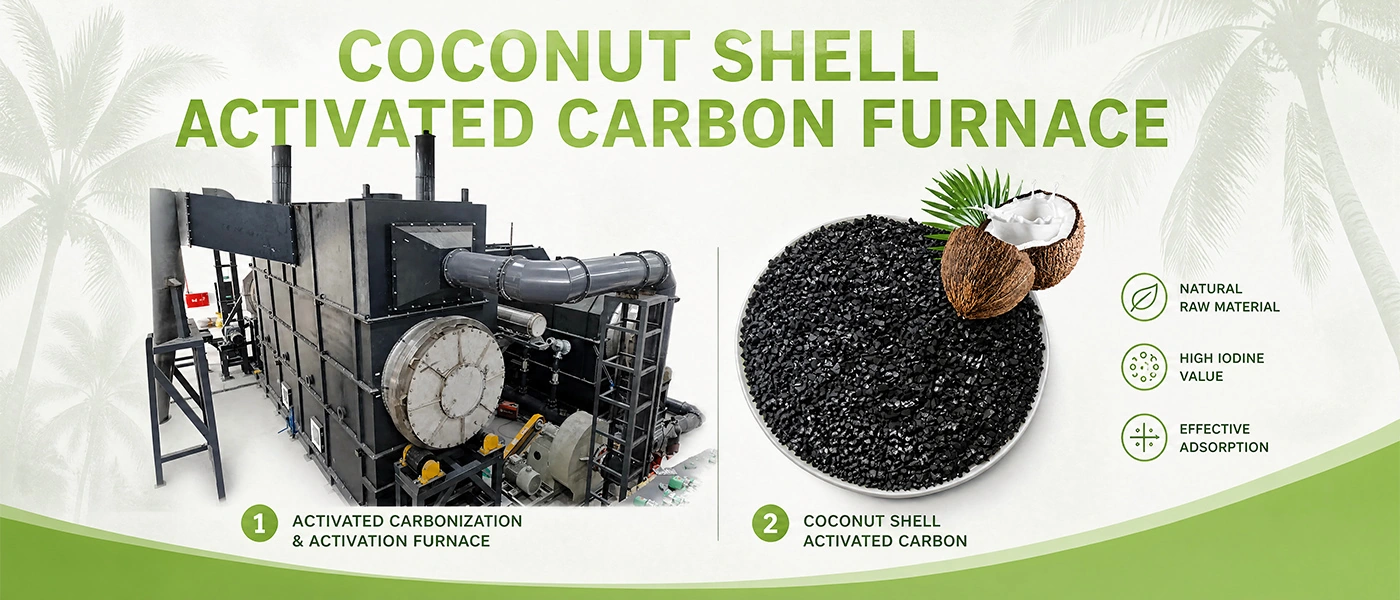
Henan Xuye Machinery Equipment Co., Ltd. provides activated carbon production equipment, rotary kiln systems, carbonization furnaces, and related process solutions. Our equipment can be configured according to raw material characteristics, required production capacity, activation methods, product specifications, and factory conditions.
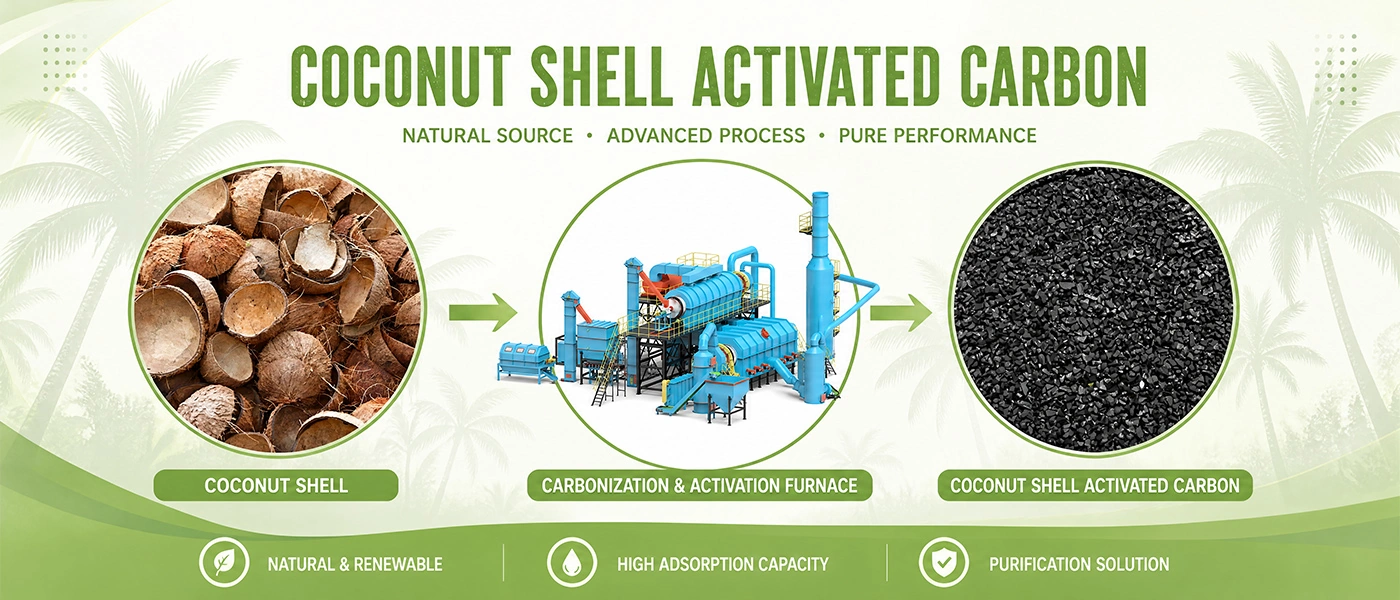
A coconut shell activated carbon production line generally includes raw material preparation, drying when required, carbonization, activation, cooling, screening, and product collection. Depending on the customer’s process requirements, carbonization and activation may be performed in separate units or through a suitably designed integrated processing system.
The rotary kiln uses a rotating cylindrical chamber to move material through a controlled thermal processing zone. As the kiln rotates, coconut shell charcoal or carbon material advances through the equipment while being exposed to the required temperature and process atmosphere.
For steam activation, steam reacts with carbon at elevated temperatures to develop pores and increase the material’s accessible surface area. The final adsorption performance depends on the raw material, carbonization conditions, activation temperature, residence time, steam consumption, and activation degree.
XUYE can assist customers in selecting a suitable rotary kiln configuration for coconut shell charcoal activation and developing a production line around their operational requirements.
What Is a Coconut Shell Activated Carbon Rotary Kiln?
A coconut shell activated carbon rotary kiln is a continuous thermal processing system that uses a rotating cylindrical chamber to treat carbon materials under controlled operating conditions.
In activated carbon manufacturing, two major thermal processes are carbonization and activation.
Карбонизация converts prepared coconut shells into carbon-rich charcoal by heating them under oxygen-limited conditions. During this process, moisture and volatile components are released, and the remaining solid material develops a carbonaceous structure.
Активация further develops the pore structure of the carbonized material. Steam activation is commonly used in coconut shell activated carbon production. At high temperatures, steam reacts with carbon and creates or enlarges pores within the material.
These two processes have different objectives and operating requirements. Carbonization primarily prepares the carbon material, while activation develops the pore structure needed for adsorption.
A production line may therefore use a coconut shell carbonization furnace followed by a separate activated carbon rotary kiln. Alternatively, the equipment arrangement can be customized according to the production process and plant design.
Main Functions of the Equipment
- Continuous or semi-continuous thermal processing, depending on the selected configuration.
- Controlled heating of carbon materials.
- Uniform material movement through the rotary processing chamber.
- Support for steam activation processes.
- Adjustment of operating parameters to meet different product requirements.
- Integration with feeding, cooling, gas handling, and dust collection systems.
- Adaptation to different production capacities and factory layouts.
Why Use Coconut Shells to Produce Activated Carbon?
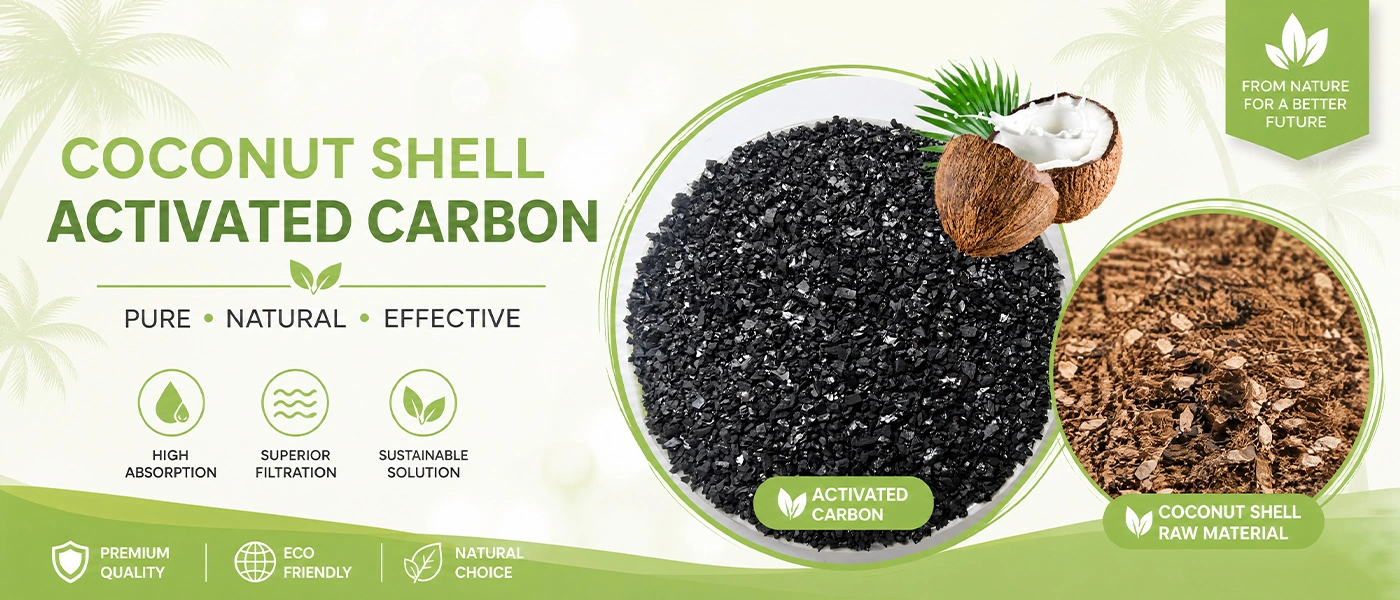
Coconut shells are an established raw material for activated carbon manufacturing, particularly for granular products used in water treatment, gas purification, and gold recovery in the mining industry.
The suitability of coconut shells comes from their carbon content, physical structure, availability in coconut-producing regions, and ability to develop useful pore structures during appropriate processing. With suitable carbonization and activation technologies, coconut shells can be converted into high-quality activated carbon for various industrial adsorption applications, including the recovery of gold from cyanide leach solutions.
1. Suitable Carbon Structure
Coconut shells can produce hard carbonaceous material after carbonization. With suitable activation conditions, the resulting carbon can develop a pore structure appropriate for various adsorption applications.
Coconut shell activated carbon is particularly valued in applications requiring good mechanical strength and abrasion resistance. These properties are important in gold mining operations, where activated carbon circulates through leaching and adsorption equipment and must withstand continuous contact with slurry and mineral particles.
The actual hardness, pore distribution, adsorption capacity, and yield depend on the raw material and manufacturing process. Appropriate carbonization temperature, activation conditions, and process control are essential for producing activated carbon that meets specific industrial requirements.
2. Applications in Granular Activated Carbon
Coconut shell activated carbon is frequently used in granular or pellet-related adsorption applications, depending on the manufacturing method.
Common applications include drinking water treatment, industrial water purification, air filtration, solvent recovery, and certain gas purification processes. Another important application is gold recovery in the mining and mineral processing industry.
In gold beneficiation, coconut shell activated carbon is widely used in cyanide leaching systems, particularly Carbon-in-Pulp (CIP) and Carbon-in-Leach (CIL) processes. During these operations, gold is dissolved from gold-bearing ores into a cyanide solution and subsequently adsorbed onto activated carbon. The gold-loaded carbon is then separated and processed through downstream recovery operations to extract the gold.
Coconut shell activated carbon is commonly selected for gold extraction because it can offer high hardness, good abrasion resistance, and a suitable pore structure when manufactured to the required specifications. These characteristics help reduce carbon degradation and losses while supporting efficient gold adsorption during continuous processing.
For customers manufacturing activated carbon for specific industries, the kiln and activation process should be designed around the required iodine number, surface area, particle size, hardness, and other product specifications. For gold mining applications, additional considerations include gold adsorption capacity, abrasion resistance, particle size distribution, and resistance to attrition under actual operating conditions.
3. Availability in Tropical Regions
Coconut shells are generated by coconut processing industries in countries such as Indonesia, the Philippines, India, Sri Lanka, Thailand, and Vietnam.
For manufacturers located near these raw material sources, local sourcing may help reduce raw material transportation requirements. Actual economic benefits depend on shell availability, moisture content, collection costs, and transportation distance.
The availability of coconut shells in these regions creates opportunities to establish activated carbon production facilities closer to agricultural raw material sources. With appropriate processing equipment, manufacturers can convert locally available coconut shells into activated carbon for domestic and international markets, including water treatment, industrial purification, and gold mining applications.
For businesses planning to supply the gold extraction industry, consistent raw material quality and reliable production processes are particularly important for maintaining the mechanical strength and adsorption performance required by mining customers.
4. Resource Utilization
Processing coconut shells into activated carbon provides a way to convert an agricultural by-product into an industrial adsorbent.
In addition to its applications in water treatment and gas purification, coconut shell activated carbon plays an important role in gold recovery from gold-bearing ores. By adsorbing dissolved gold complexes from cyanide leach solutions, activated carbon helps mining operations recover valuable metals during mineral processing.
This application adds industrial value to coconut shells and creates opportunities for activated carbon manufacturers to serve the mining and precious metal recovery sectors. The commercial value of the final product depends on its adsorption performance, mechanical properties, production costs, and compliance with customer specifications.
An appropriately designed production system can support resource utilization while managing process gases, particulate emissions, and other by-products through suitable collection and treatment equipment. For manufacturers targeting the gold mining industry, the production line should be configured to achieve the required carbonization and activation conditions, ensuring that the finished activated carbon meets the technical requirements of gold adsorption applications.
Working Principle of the Coconut Shell Activated Carbon Rotary Kiln
The working principle is based on controlled heating, continuous material movement, and the chemical reactions required to develop the activated carbon pore structure.
The exact process varies according to whether the customer needs carbonization, steam activation, or both.
Step 1: Raw Material Preparation
Coconut shells are collected and prepared before thermal processing.
Depending on their initial condition, preparation may include cleaning, removal of foreign materials, crushing, screening, and drying.
The feed size should match the requirements of the selected carbonization furnace and downstream equipment. Excessively large pieces may require additional crushing, while excessive fines may affect feeding, gas flow, and material handling.
If the raw material contains significant moisture, a drying system may be installed to help stabilize the feed and improve process control.
Step 2: Carbonization
Prepared coconut shells enter a carbonization furnace, where they are heated under oxygen-limited conditions.
During carbonization, moisture and volatile compounds are released, and the solid material is converted into coconut shell charcoal.
Temperature, heating rate, residence time, and feedstock properties influence charcoal yield, volatile content, and physical structure.
Carbonization gases may contain combustible components. Where the gas composition, process conditions, and equipment design permit, suitable gas collection and combustion systems can recover their energy for process heating. Gas handling must be designed with appropriate pressure control, safety devices, and emission treatment.
Step 3: Charcoal Feeding
After carbonization, the coconut shell charcoal is transferred to the activation section.
Depending on the production line design, transfer may involve a sealed conveyor, screw feeder, hopper, or other material handling equipment.
Stable feeding helps maintain consistent kiln loading and residence time. The transfer system must also account for the high temperature and physical properties of the charcoal.
Step 4: High-Temperature Steam Activation
In a steam activation rotary kiln, carbonized coconut shell material is heated to the required activation temperature.
Steam is introduced into the activation zone and reacts with carbon according to the selected operating conditions.
The activation temperature for industrial steam activation is commonly in the approximate range of 850–900°C, although the appropriate operating temperature must be established through process testing and equipment design.
The main objective is to develop an appropriate pore structure without excessive carbon burn-off.
Important operating variables include:
- Activation temperature.
- Steam flow rate and distribution.
- Material residence time.
- Feedstock characteristics.
- Carbon loading and kiln rotation.
- Gas flow and exhaust conditions.
- Target adsorption properties.
Insufficient activation may produce material with limited adsorption performance. Excessive activation can increase carbon consumption and reduce product yield.
Consequently, activation conditions should be optimized for the customer’s product specifications rather than selected according to temperature alone.
Step 5: Cooling
Activated carbon discharged from the rotary kiln is still hot and may react with oxygen if exposed to unsuitable conditions.
A suitable cooling system reduces the material temperature before screening, storage, or packaging. Depending on the equipment arrangement, cooling may be carried out using a rotary cooler or another appropriate cooling device.
Cooling conditions and material transfer arrangements should minimize contamination, uncontrolled oxidation, and unnecessary product loss.
Step 6: Screening and Collection
After cooling, the activated carbon can be screened to separate different particle sizes.
Depending on the customer’s product requirements, additional steps may include crushing, classification, washing, drying, or packaging.
The finished product is evaluated against relevant specifications, which may include particle size distribution, moisture content, ash content, iodine number, hardness, and other adsorption or physical properties.
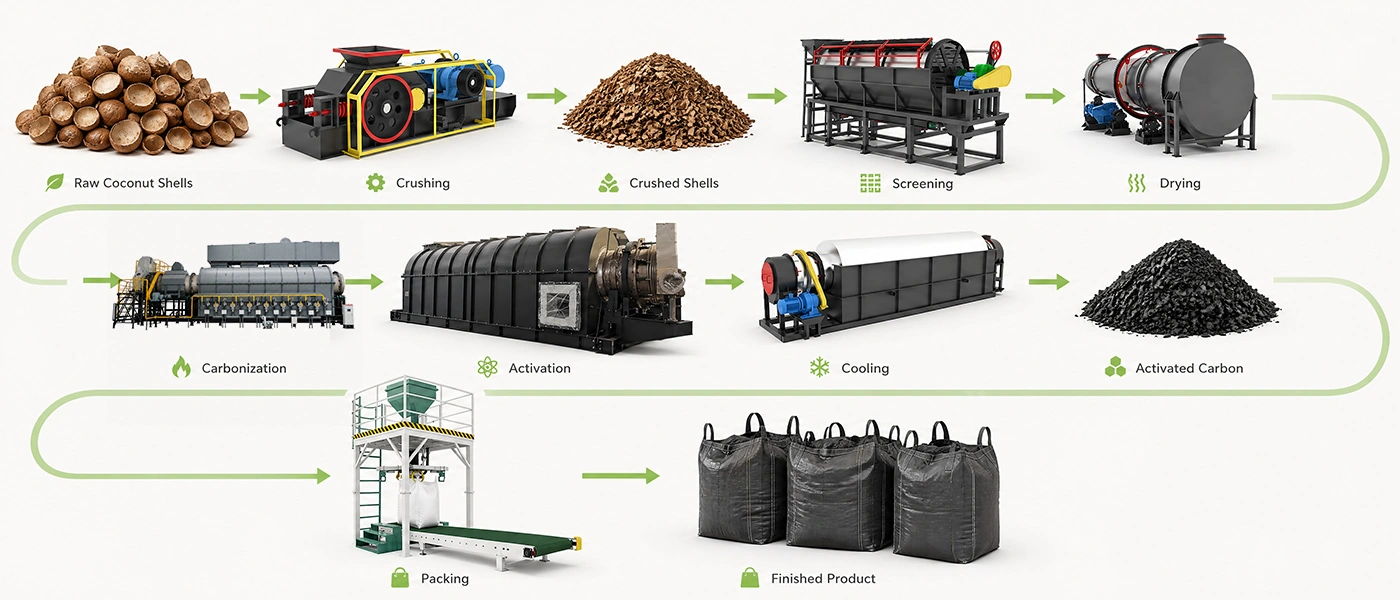
Main Features of XUYE Coconut Shell Activated Carbon Rotary Kiln
XUYE rotary kiln systems can be configured to suit different feedstocks, production capacities, and activated carbon manufacturing processes.
1. Rotary Processing Design
The rotating cylinder moves carbon material through the thermal processing zone. Its rotation, inclination, and operating speed can be selected according to the equipment design and material characteristics.
A properly designed feeding and discharge system supports continuous material movement and stable operation.
2. Controlled Thermal Processing
The heating system and temperature monitoring arrangement can be configured according to the required carbonization or activation process.
Multiple temperature measurement points may be used where required to monitor the thermal profile along the kiln.
The final control system depends on the selected configuration and may incorporate automated temperature regulation, motor control, alarms, and other process monitoring functions.
3. Steam Activation Compatibility
For customers producing steam-activated coconut shell carbon, the system can incorporate steam supply and distribution equipment.
Steam flow, temperature, and distribution should be matched to the activation process to achieve the desired pore development and product quality.
4. Flexible Production Line Configuration
The rotary kiln can be integrated with raw material preparation, carbonization, feeding, cooling, screening, and collection equipment.
The final arrangement depends on the plant’s production target, available space, utilities, environmental requirements, and the desired degree of automation.
5. Gas Collection and Treatment Options
Thermal processing generates exhaust gases that require appropriate collection and treatment.
Depending on the process, the system may include gas ducts, combustion chambers, heat recovery arrangements, dust collection equipment, and exhaust treatment units.
Combustible gas recovery is subject to gas composition, temperature, operating stability, and safety requirements. It should not be assumed that every process gas can be directly reused without additional treatment or control.
6. Customizable Control System
An electrical control system can be configured to monitor and regulate key operating parameters.
Possible functions include kiln drive control, feeding adjustment, temperature monitoring, steam flow regulation, and alarms for selected abnormal operating conditions.
The specific control functions and automation level should be confirmed in the technical proposal.
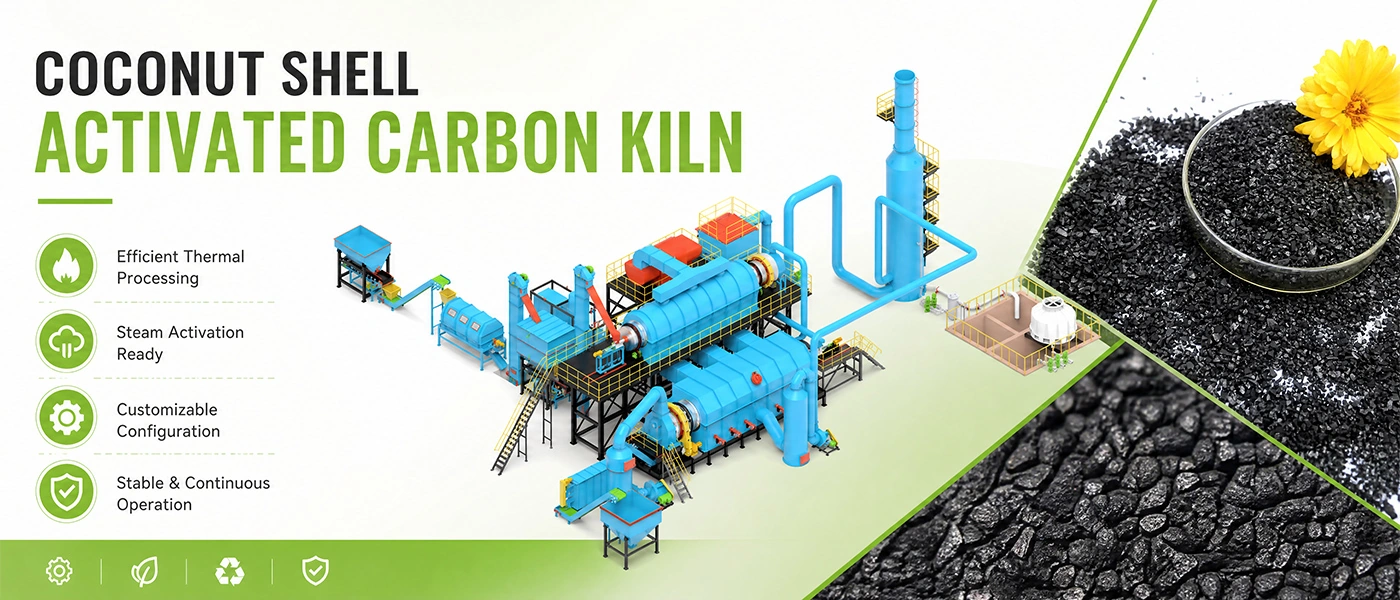
Coconut Shell Activated Carbon Production Line
A coconut shell activated carbon production line combines thermal processing equipment with material handling, cooling, screening, and supporting systems.
The production line can be configured for different output targets and product requirements.
Typical Production Process
Raw Coconut Shells → Cleaning and Screening → Crushing if Required → Drying if Required → Carbonization → Charcoal Transfer → Steam Activation → Cooling → Screening → Finished Activated Carbon
The exact process may differ according to whether the customer purchases raw coconut shells or already carbonized coconut shell charcoal.
1. Raw Material Preparation Equipment
Preparation equipment removes foreign materials and brings the feedstock to a suitable size and moisture condition.
Depending on the raw material, the preparation section may include a crusher, vibrating screen, dryer, conveyor, and storage hopper.
2. Carbonization Furnace
The carbonization section converts coconut shells into carbon-rich charcoal under oxygen-limited conditions.
Its design should match the raw material size, required throughput, heating method, and desired charcoal properties.
Customers who already purchase carbonized coconut shell charcoal may not need a carbonization furnace in the initial project scope.
3. Activated Carbon Rotary Kiln
The activation rotary kiln is the main thermal processing unit for steam activation.
It provides the processing environment in which carbonized material reacts with steam to develop the required pore structure.
The kiln should be selected according to the target production capacity, material residence time, operating temperature, and desired product characteristics.
4. Cooling Equipment
A cooling unit reduces the temperature of discharged activated carbon before subsequent handling.
Its capacity and design should match the kiln output and required discharge temperature.
5. Screening and Packaging Equipment
Screening equipment separates activated carbon into the required particle size ranges.
The final section may include intermediate storage, conveying, weighing, and packaging equipment. Additional processing may be required for products that need washing or specialized particle classification.
6. Environmental Protection System
An industrial activated carbon plant should include appropriate exhaust gas management.
Depending on the process, the environmental protection system may include combustion equipment, dust collection, gas cooling, and other exhaust treatment units.
The required configuration should be determined from the actual gas composition, emission limits, and local environmental regulations.

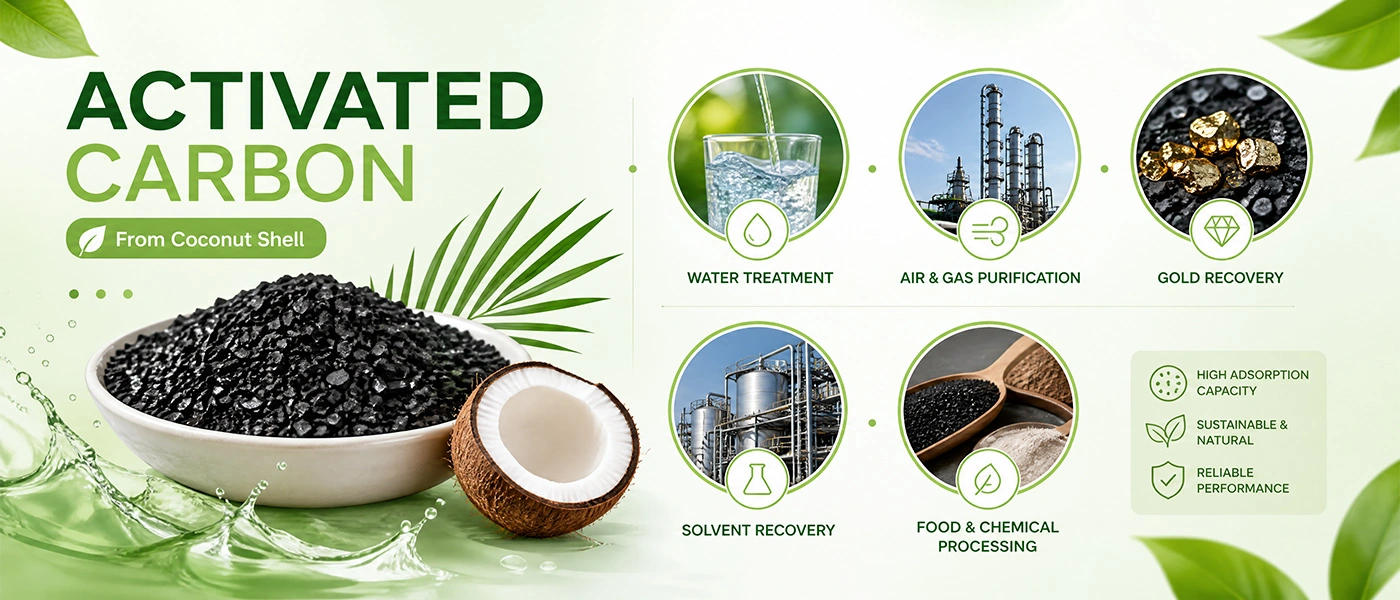
Applications of Coconut Shell Activated Carbon
Activated carbon produced from coconut shells is used in applications that require adsorption of contaminants from liquids or gases.
The suitability of the finished product depends on its pore structure, surface chemistry, particle size, hardness, and the characteristics of the target contaminant.
Очистка воды
Coconut shell activated carbon is used in drinking water treatment, industrial water purification, and certain wastewater treatment processes.
It can help remove selected organic compounds, taste and odor compounds, and other adsorbable substances when the carbon grade and treatment conditions are appropriate.
Air and Gas Purification
Activated carbon is used in air filtration and industrial gas treatment to adsorb certain volatile organic compounds and other contaminants.
The required carbon specification depends on the gas composition, humidity, operating temperature, and target removal performance.
Восстановление золота
Certain granular coconut shell activated carbon grades are used in gold recovery processes, including carbon-in-pulp and carbon-in-leach operations.
Hardness, particle size, adsorption performance, and resistance to abrasion are important selection criteria for these applications.
Industrial Solvent Recovery
Activated carbon can be used in selected solvent recovery systems to capture organic vapors.
The carbon grade and regeneration method must be suitable for the solvent and operating conditions.
Food and Chemical Processing
Activated carbon is used in certain purification and decolorization applications in the food, beverage, and chemical industries.
Product quality requirements and applicable regulations should be considered when manufacturing carbon intended for these uses.
Technical Specifications
| Вместимость | 5-8 т/д | 8-10t/d | 10-12t/d | 12-15t/d | 15-20t/d |
| Dryer model | HG-800 | HG-1000 | HG-1200 | HG-1500 | HG-1800 |
| Dryer power | 3kw | 4kw | 7.5kw | 15kw | 22kw |
| continuous carbonization furnace model | TH-1500 | TH-1500 | TH-1800 | TH-2000 | TH-2000 |
| Carbonization temperature | 600-850℃ | ||||
| Fixed carbon content after carbonization | 70-80% | ||||
| Carbonization furnace drum material | 309S/310S | 309S/310S | 309S/310S | 309S/310S | 309S/310S |
| Activation furnace model | HN-5 | HN-8 | HN-10 | HN-12 | HN-15 |
| Activation furnace power | 15kw | 22kw | 30kw | 37kw | 37kw |
| Activation furnace chamber material | QQ345+nano thermal insulation board+refractory | ||||
| Activation temperature | 850-950℃ | ||||
| Активатор | Water vapor or Phosphoric acid (customized according to customer requirements, equipment design will be updated) | ||||
| Activation time | 1-2h | ||||
| Cooling machine model | GTL-1004 | GTL-1204 | GTL-1206 | GTL-1504 | GTL-1506 |
| Temperature after cooling | ≤40℃ | ||||
| Activated carbon crusher model | SGP-400 | SGP-400 | SGP-600 | SGP-800 | SGP-800 |
| Activated carbon finished product size | 4-60mesh | ||||
| Activated carbon iodine value | 800-1300mg/g | ||||
| Activated carbon specific surface area | 800-1500m²/g | ||||
| Activated carbon strength | ≥95 | ||||
| CTC | ≥60% | ||||
| Filling density | 0.45-0.55g/cm3 | ||||
| Activated carbon ash | ≤3% | ||||
Factors Affecting Activated Carbon Quality
The performance of a coconut shell activated carbon rotary kiln cannot be evaluated by equipment temperature alone. Product quality is influenced by the complete manufacturing process.
Raw Material Quality
Coconut shell moisture, ash content, contamination, particle size, and carbon composition can influence the process and finished product.
Consistent feedstock preparation helps improve process stability.
Carbonization Conditions
Carbonization temperature, heating rate, residence time, and oxygen control affect the structure of the resulting charcoal.
These factors also influence the amount of volatile matter remaining before activation.
Activation Temperature and Time
Activation temperature and residence time determine how the pore structure develops.
A higher temperature or longer activation time does not automatically produce a better product. Excessive activation may consume too much carbon and reduce yield.
Steam Distribution
Uniform steam delivery is important for consistent activation.
Steam supply conditions should be selected according to the kiln design, material loading, and process requirements.
Residence Time and Material Movement
Kiln rotation speed, inclination, internal design, and feed rate influence the movement of carbon material through the activation zone.
Stable material movement helps maintain a more consistent treatment history.
Cooling and Storage
Activated carbon should be cooled and stored under appropriate conditions to reduce the risk of oxidation, contamination, and moisture-related quality changes.
Finished product testing should be used to verify whether the process meets the customer’s specifications.
Why Work with Henan Xuye Machinery?
Henan Xuye Machinery Equipment Co., Ltd. manufactures and supplies activated carbon equipment, carbonization furnaces, dryer equipment, and related industrial thermal processing machinery.
Our work focuses on matching equipment configurations to the customer’s raw materials, process requirements, production targets, and factory conditions.
Equipment and Production Line Solutions
We can discuss individual machines as well as coordinated production line configurations. Depending on project requirements, a proposal may cover carbonization, activation, cooling, material handling, and supporting equipment.
Customized Technical Configuration
Production capacity, kiln dimensions, heating arrangements, feeding systems, and auxiliary equipment should be selected according to the intended application.
Our team can evaluate the information supplied by the customer and prepare a proposed configuration for technical confirmation.
Manufacturing and Equipment Coordination
A complete project may involve several equipment units that must operate together. Coordinating feeding, thermal processing, cooling, and material transfer is important for establishing a workable production process.
International Project Communication
For overseas customers, clear communication about raw materials, process conditions, installation requirements, electrical standards, and environmental regulations helps reduce uncertainty during project planning.
Technical Information Before Purchase
Customers are encouraged to discuss their intended product specifications and raw material conditions before confirming an order.
Equipment selection should be based on the actual process requirements rather than on general descriptions or nominal capacity figures alone.
Contact XUYE to discuss a coconut shell activated carbon rotary kiln or a complete activated carbon production line for your project.
Certificate
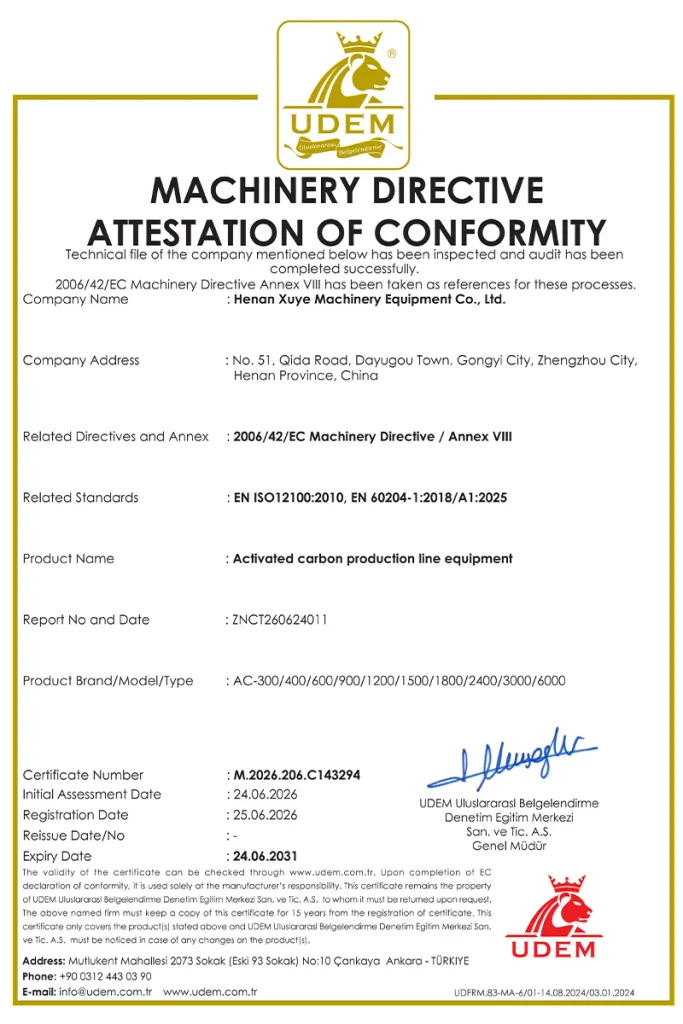
CE Certificate
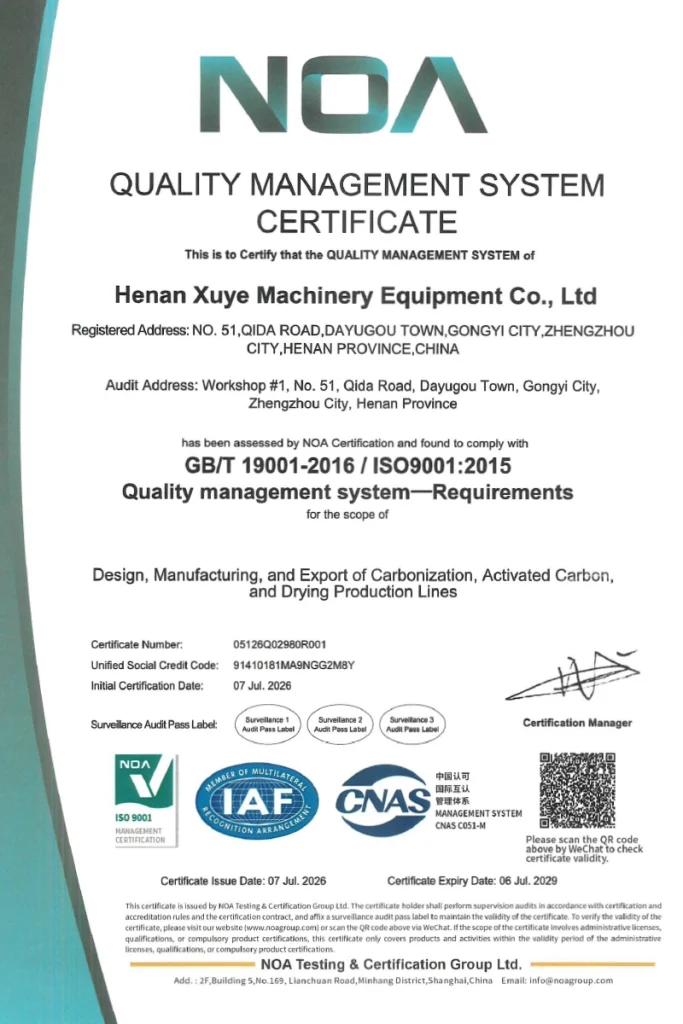
ISO Quality Management Certificate
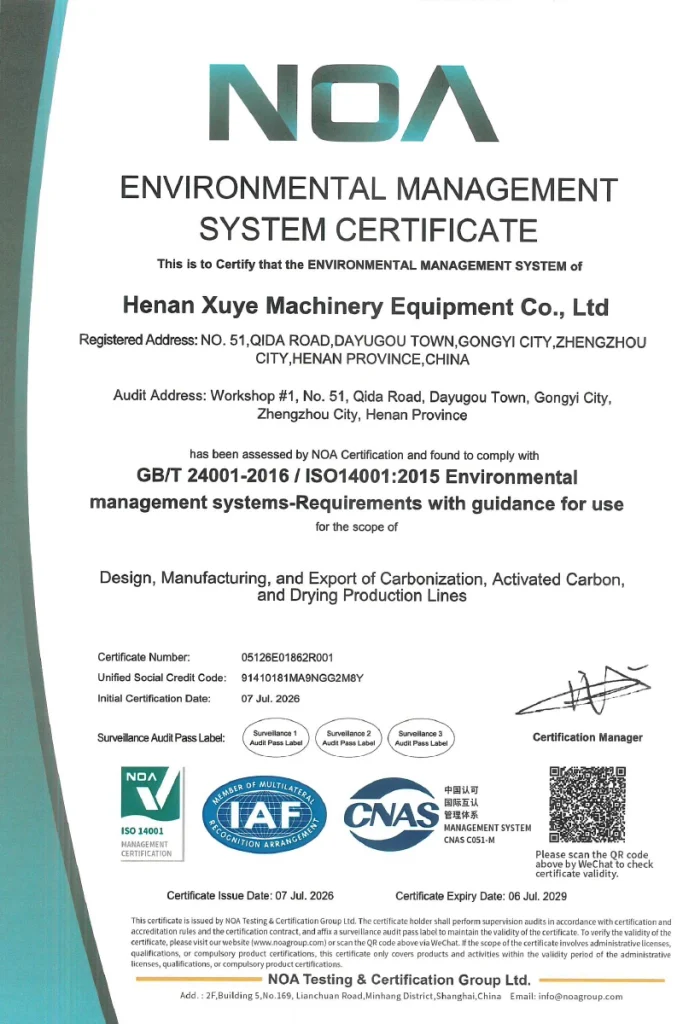
ISO Environmental Management Certificate
Case
FAQ
Frequently Asked Questions About Activated Carbon Production Lines
Common raw materials include coconut shells, coal, wood, nutshells, and other carbon-rich biomass materials. The choice of raw material depends on the desired activated carbon properties, local availability, production costs, and the intended application. Different raw materials may require different processing methods and equipment configurations.
The production capacity depends on the equipment model, raw material type, moisture content, processing method, operating temperature, and required product quality. Xu Ye Machinery can recommend a suitable equipment configuration according to the customer’s target output and project requirements. Customers should confirm whether the specified capacity refers to raw material input or finished activated carbon output.
Yes. Equipment configuration can be tailored to the raw material, target production capacity, available factory space, energy source, automation requirements, and finished product specifications. Customization may include furnace type, feeding and discharging systems, temperature control, auxiliary equipment, and environmental protection systems. A technical assessment is recommended before finalizing the production line.
Yes. Xu Ye Machinery can provide successful project cases for reference, including activated carbon production line installations and equipment commissioning projects in different countries. These cases help customers better understand our equipment, production processes, and project implementation experience. Please contact us to learn more about relevant projects and find a suitable solution for your production needs.
A carbonization furnace converts raw materials into carbon-rich char through heating under oxygen-limited conditions. An activation furnace further develops the pore structure of the carbonized material to improve its adsorption properties. Carbonization and activation are two different stages of activated carbon production, and each requires appropriate process conditions and equipment.
Energy consumption varies according to the equipment design, production capacity, raw material moisture, process temperature, heat recovery system, and operating conditions. A reliable energy estimate should be based on the proposed equipment configuration and process requirements. Customers should evaluate fuel or electricity consumption together with auxiliary equipment, exhaust-gas treatment, and other operating costs.
The installation and commissioning period depends on the production line size, equipment configuration, site preparation, foundation work, utility connections, and local operating conditions. Before installation, customers should prepare the required space, foundations, power supply, fuel supply, and environmental protection facilities according to the technical drawings. The installation schedule should be confirmed with the equipment supplier for each project.
Xu Ye Machinery can discuss technical support and after-sales service arrangements according to the project requirements and sales agreement. Customers should confirm the scope of installation guidance, commissioning support, operator training, spare parts supply, warranty coverage, and remote technical assistance before placing an order.
