 XUYE 장비


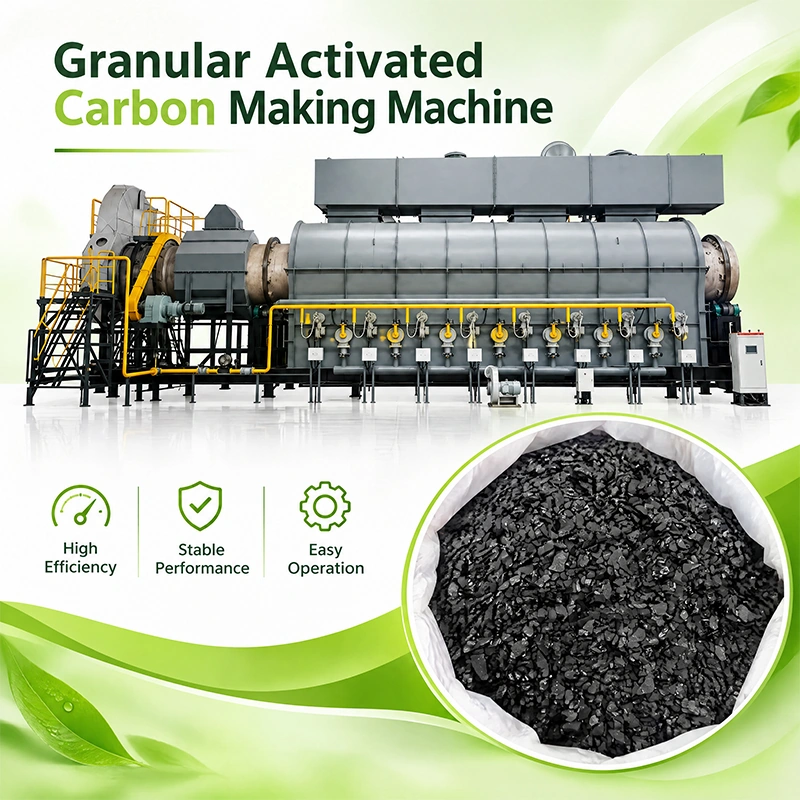
Granular Activated Carbon Making Machine
The Granular Activated Carbon Making Machine is designed for processing biomass materials and carbon-rich raw materials into granular activated carbon (GAC). It integrates material preparation, drying, carbonization, activation, cooling, and screening processes to provide an industrial production solution for granular activated carbon manufacturers.
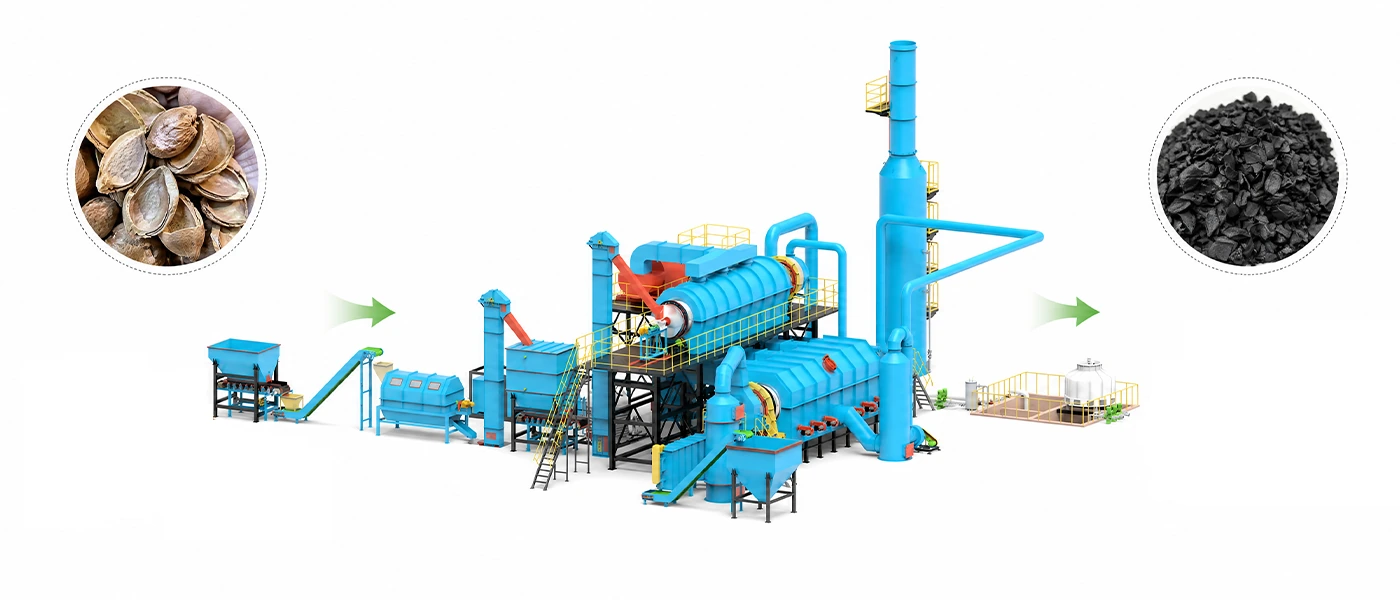
Henan Xuye Machinery provides granular activated carbon production equipment for different raw materials, including coconut shells, palm kernel shells, wood, hazelnut shells, almond shells, and other suitable biomass materials. According to the raw material characteristics, required product specifications, and production capacity, the equipment configuration can be customized for different manufacturing requirements.
Our granular activated carbon making machine can be configured with rotary carbonization furnaces, activation furnaces, drying systems, cooling equipment, screening machines, and gas recovery systems. The production line can be designed for continuous operation, with temperature control and combustible gas recovery according to the selected process.
Whether you are planning a new granular activated carbon manufacturing plant or upgrading an existing production facility, XUYE Machinery can provide equipment configuration and technical solutions based on your production requirements.
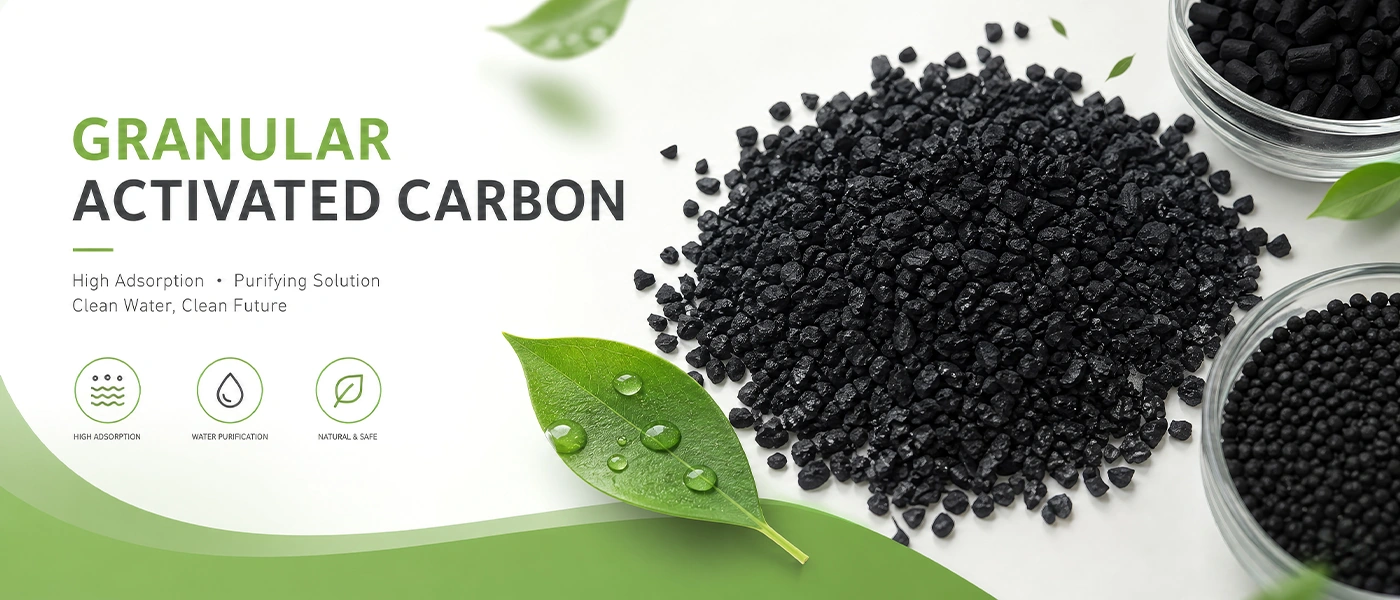
What Is Granular Activated Carbon?
Granular Activated Carbon (GAC) is a porous carbon material processed into granules of different sizes. It is widely used in water purification, air filtration, industrial wastewater treatment, solvent recovery, and other adsorption applications.
Compared with powdered activated carbon, granular activated carbon has a larger particle size, making it suitable for fixed-bed adsorption systems, filtration vessels, and industrial treatment equipment.
The production process generally includes carbonization and activation. During carbonization, organic materials are heated under controlled oxygen conditions to remove volatile components and produce carbonaceous material. During activation, the carbonized material undergoes physical or chemical activation to develop its pore structure and adsorption properties.
The final characteristics of granular activated carbon depend on the raw material, carbonization conditions, activation method, activation time, and subsequent processing.
Suitable Raw Materials for Granular Activated Carbon Production
The granular activated carbon making machine can be configured to process various carbon-rich raw materials. Different materials require different preparation and processing conditions.
1. Coconut Shell
Coconut shell is one of the commonly used raw materials for producing high-quality granular activated carbon. Its dense structure and high fixed carbon content make it suitable for manufacturing activated carbon used in water treatment, gold recovery, and gas purification.
The production process generally includes shell crushing, drying, carbonization, activation, cooling, and screening.
2. Palm Kernel Shell
Palm kernel shell is an agricultural by-product generated during palm oil processing. It can be converted into granular activated carbon through controlled carbonization and activation.
The equipment configuration depends on shell size, moisture content, and the required granular activated carbon specifications.
3. Wood
Wood and wood-based materials can be processed into granular activated carbon after appropriate size reduction and pretreatment.
Wood-based granular activated carbon is used in various adsorption applications. Raw material preparation and activation conditions need to be adjusted according to wood species and product requirements.
4. Hazelnut Shell
Hazelnut shells are suitable carbon-rich biomass materials for activated carbon manufacturing.
After drying and carbonization, the resulting carbon material can undergo steam activation to develop the required pore structure. XUYE Machinery can provide customized equipment solutions for hazelnut shell activated carbon production.
5. Almond Shell and Apricot Pits
Almond shells and apricot pits are also potential raw materials for granular activated carbon production.
Their processing requirements depend on the original particle size, hardness, moisture content, and desired final product specifications.
6. Date Pits
Date pits can be utilized as carbonaceous raw materials after cleaning, drying, and appropriate pretreatment. Carbonization and activation conditions should be determined through raw material testing.ption.
Granular Activated Carbon Production Process
A typical granular activated carbon manufacturing process includes raw material preparation, drying, carbonization, activation, cooling, screening, and packaging.
The exact process flow depends on the raw material and the required granular activated carbon properties.
Step 1: Raw Material Preparation
Raw materials are cleaned and processed to remove impurities. Crushing and screening equipment can be used to obtain a suitable particle size for subsequent processing.
Proper raw material preparation helps improve feeding stability and process consistency.
Step 2: Drying
The prepared materials are fed into a rotary dryer to reduce moisture content.
Drying conditions depend on the original moisture level, material characteristics, and carbonization requirements. A suitable drying process helps maintain stable operation of the carbonization system.
Step 3: Carbonization
The dried raw materials are fed into a carbonization furnace, where they are heated under controlled oxygen conditions.
During this stage, volatile components are released and the organic materials are converted into carbon-rich solid materials.
A rotary carbonization furnace can be used for continuous material processing. The operating temperature and residence time should be determined according to the specific raw material.
Combustible gases generated during carbonization can be collected and directed to a combustion chamber for thermal utilization when the system is properly designed.
Step 4: Activation
Activation is an important stage in granular activated carbon manufacturing.
The carbonized material is transferred to an activation furnace, where it reacts with suitable activating agents to develop a porous structure.
For physical activation, steam is commonly used as an activating agent. The activation process generally takes place at high temperatures, often around 850–900°C, depending on the material and process design.
During activation, controlled reactions create and enlarge pores within the carbon structure, improving its adsorption performance.
Step 5: Cooling
After activation, the hot granular activated carbon needs to be cooled under suitable conditions.
A cooling system can reduce material temperature before screening and packaging. Appropriate cooling and handling help prevent unwanted oxidation and protect the finished product.
Step 6: Screening and Classification
The cooled activated carbon is transferred to a screening machine for particle size classification.
Different screens can be selected according to the customer’s required particle size distribution.
Oversized and undersized materials can be handled according to the production process and product quality requirements.
Step 7: Packaging
The qualified granular activated carbon is transferred to the packaging section.
Packaging specifications can be selected according to customer requirements, such as bags, bulk bags, or other industrial packaging formats.
Main Equipment of Granular Activated Carbon Production Line
A complete granular activated carbon production line consists of several processing units. Equipment selection depends on production capacity, raw materials, activation method, and final product specifications.
1. Raw Material Preparation Equipment
Crushers, screens, conveyors, and feeding systems are used to prepare raw materials before drying and carbonization.
2. Rotary Dryer
The rotary dryer reduces moisture content in biomass materials before carbonization.
The dryer can be designed according to material characteristics, processing capacity, and available heating sources.
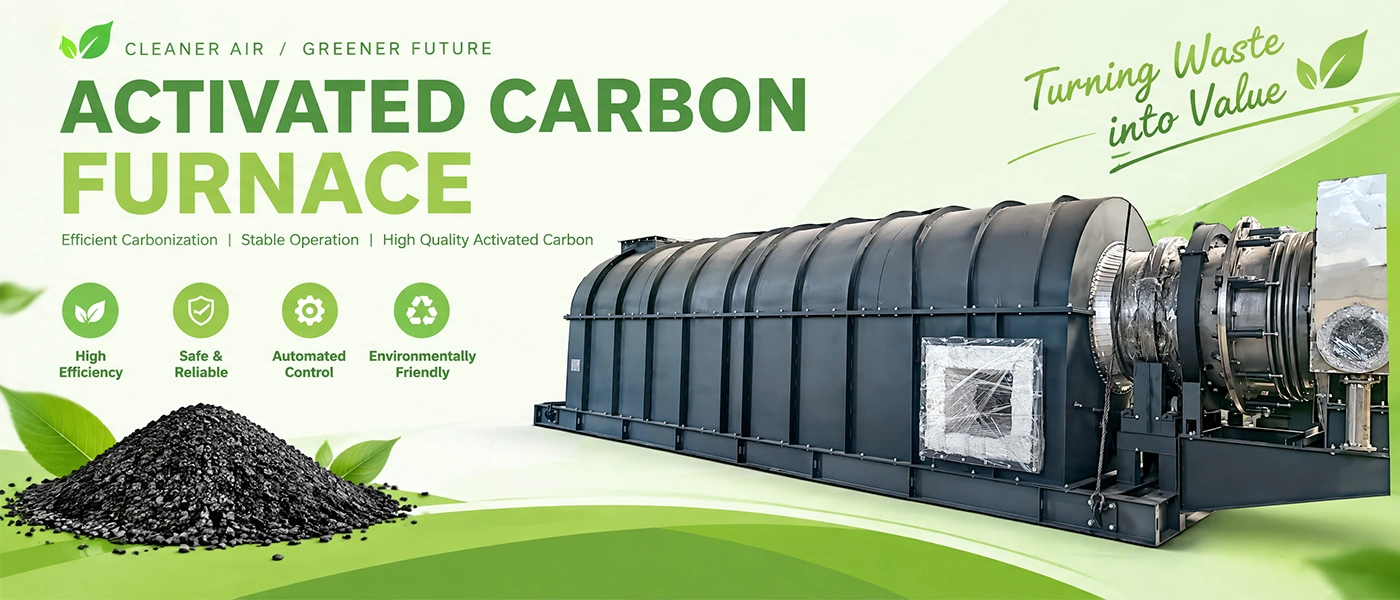
3. Carbonization Furnace
The carbonization furnace converts dried biomass materials into carbon-rich materials through controlled thermal decomposition.
XUYE can configure rotary carbonization furnaces for continuous production requirements. Heating methods and furnace structures are selected according to the raw material and production process.
4. Activation Furnace
The activation furnace is used to develop the pore structure of carbonized materials through high-temperature activation.
For steam activation, the system includes heating equipment, steam supply, temperature control, and material feeding and discharging systems.
5. Cooling Equipment
Cooling equipment reduces the temperature of activated carbon before further processing.
6. Screening Machine
The screening machine classifies granular activated carbon into different particle size ranges according to customer specifications.
7. Gas Recovery and Combustion System
Carbonization produces combustible gases and other volatile compounds.
A properly designed gas collection and combustion system can recover combustible gas for use as a supplementary heat source. Gas treatment and combustion equipment should be selected according to the actual gas composition and environmental requirements.
Working Principle of Granular Activated Carbon Making Machine
The granular activated carbon manufacturing process mainly involves two important thermal treatment stages: carbonization and activation.
During carbonization, the raw material is heated under controlled oxygen conditions. Organic compounds undergo thermal decomposition, releasing volatile substances and leaving behind carbon-rich solid material.
During activation, the carbonized material reacts with steam or other suitable activating agents at high temperatures. These reactions develop the internal pore structure of the carbon material.
For steam activation, the operating temperature is commonly within the range of approximately 850–900°C, although the actual temperature depends on the raw material and production requirements.
The activation process affects several important product properties, including:
- Specific surface area
- Pore volume
- Pore size distribution
- Iodine adsorption value
- Hardness and abrasion resistance
- Adsorption performance
These properties need to be evaluated through product testing rather than determined solely by equipment operating parameters.
Applications of Granular Activated Carbon
Granular activated carbon is widely used in industrial adsorption and purification processes.
수처리
Granular activated carbon is commonly used in drinking water treatment, industrial water purification, and wastewater treatment systems to remove certain organic contaminants, odors, and other adsorbable substances.
Air and Gas Purification
GAC is used in air filtration systems and industrial gas treatment equipment to adsorb certain volatile organic compounds, odors, and gaseous contaminants.
Industrial Wastewater Treatment
Granular activated carbon can be used in adsorption units for treating industrial wastewater containing suitable organic pollutants.
Food and Beverage Industry
Activated carbon is used in certain purification and decolorization processes in food and beverage production, subject to applicable product quality and regulatory requirements.
골드 복구
Certain grades of granular activated carbon are used in gold adsorption processes, particularly in carbon-in-pulp (CIP) and carbon-in-leach (CIL) systems.
The required hardness, particle size, and adsorption properties depend on the specific application.
Advantages of XUYE Granular Activated Carbon Making Machine
Continuous Production Design
Rotary kiln systems can be configured for continuous feeding and discharging, supporting industrial-scale granular activated carbon production.
Flexible Raw Material Processing
The production line can be designed for different carbon-rich materials, including coconut shells, palm kernel shells, wood, hazelnut shells, and other biomass materials.
Combustible Gas Recovery
Combustible gases generated during carbonization can be collected and burned in a suitable combustion system, helping utilize the thermal energy contained in process gases.
Temperature Control
The furnace system can be equipped with temperature monitoring and control components to maintain the required operating conditions.
Customized Production Capacity
The equipment configuration can be adjusted according to the customer’s required daily output, raw material properties, and factory conditions.
Complete Production Line Solutions
XUYE Machinery can provide individual machines or integrated production line configurations, including drying, carbonization, activation, cooling, screening, and auxiliary systems.
Technical Specifications
| 용량 | 5-8t/d | 8-10t/d | 10-12t/d | 12-15t/d | 15-20t/d |
| Dryer model | HG-800 | HG-1000 | HG-1200 | HG-1500 | HG-1800 |
| Dryer power | 3kw | 4kw | 7.5kw | 15kw | 22kw |
| continuous carbonization furnace model | TH-1500 | TH-1500 | TH-1800 | TH-2000 | TH-2000 |
| Carbonization temperature | 600-850℃ | ||||
| Fixed carbon content after carbonization | 70-80% | ||||
| Carbonization furnace drum material | 309S/310S | 309S/310S | 309S/310S | 309S/310S | 309S/310S |
| Activation furnace model | HN-5 | HN-8 | HN-10 | HN-12 | HN-15 |
| Activation furnace power | 15kw | 22kw | 30kw | 37kw | 37kw |
| Activation furnace chamber material | QQ345+nano thermal insulation board+refractory | ||||
| Activation temperature | 850-950℃ | ||||
| 액티베이터 | Water vapor or Phosphoric acid (customized according to customer requirements, equipment design will be updated) | ||||
| Activation time | 1-2h | ||||
| Cooling machine model | GTL-1004 | GTL-1204 | GTL-1206 | GTL-1504 | GTL-1506 |
| Temperature after cooling | ≤40℃ | ||||
| Activated carbon crusher model | SGP-400 | SGP-400 | SGP-600 | SGP-800 | SGP-800 |
| Activated carbon finished product size | 4-60mesh | ||||
| Activated carbon iodine value | 800-1300mg/g | ||||
| Activated carbon specific surface area | 800-1500m²/g | ||||
| Activated carbon strength | ≥95 | ||||
| CTC | ≥60% | ||||
| Filling density | 0.45-0.55g/cm3 | ||||
| Activated carbon ash | ≤3% | ||||
Certificate
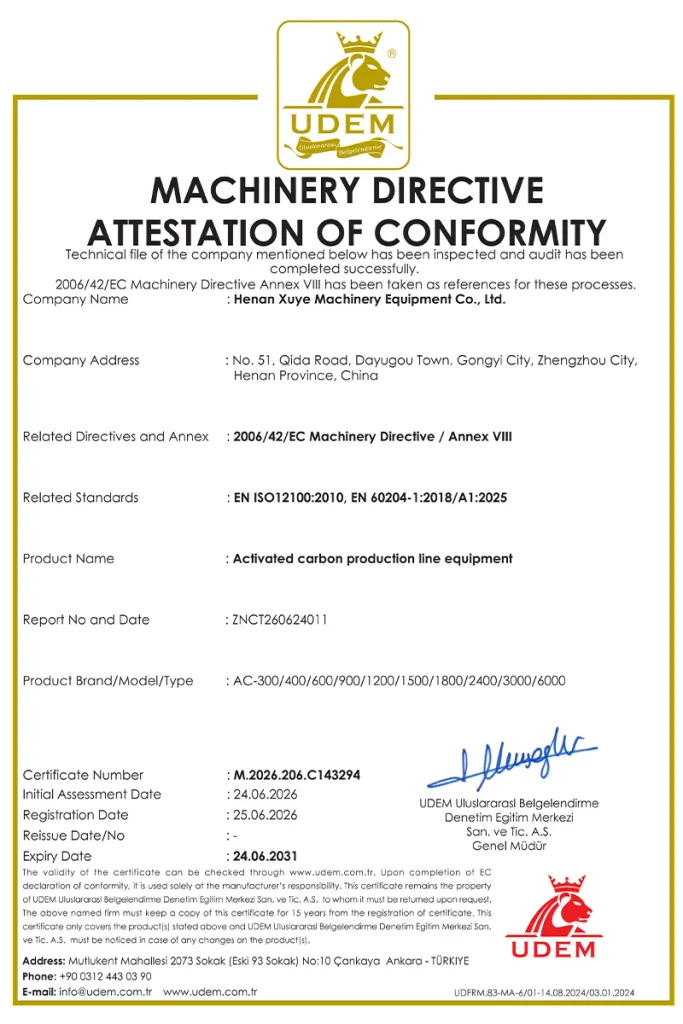
CE Certificate
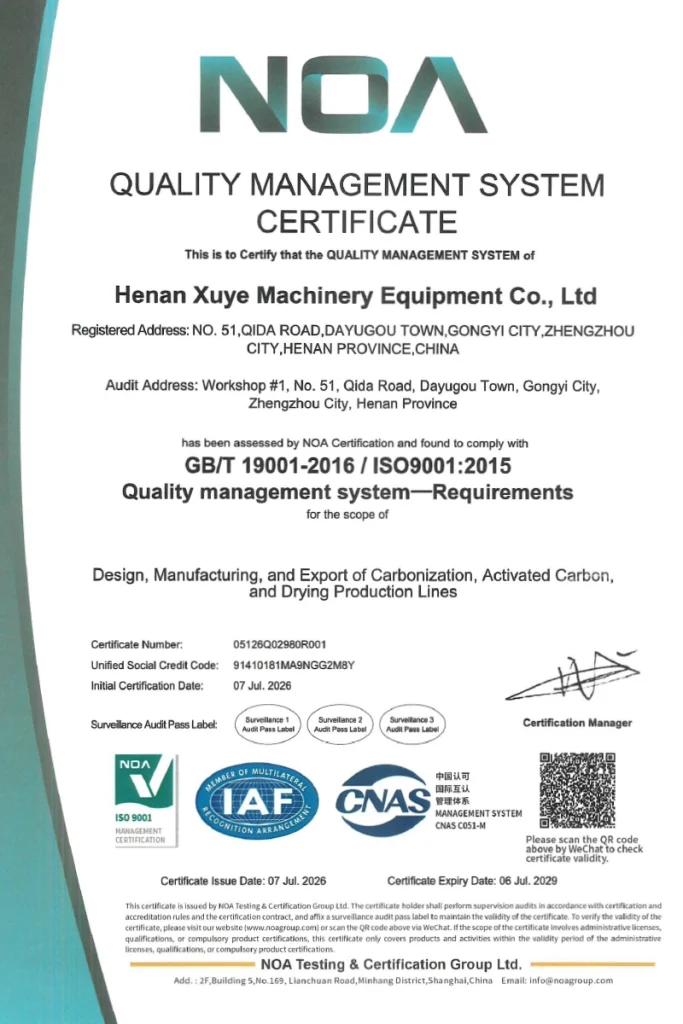
ISO Quality Management Certificate
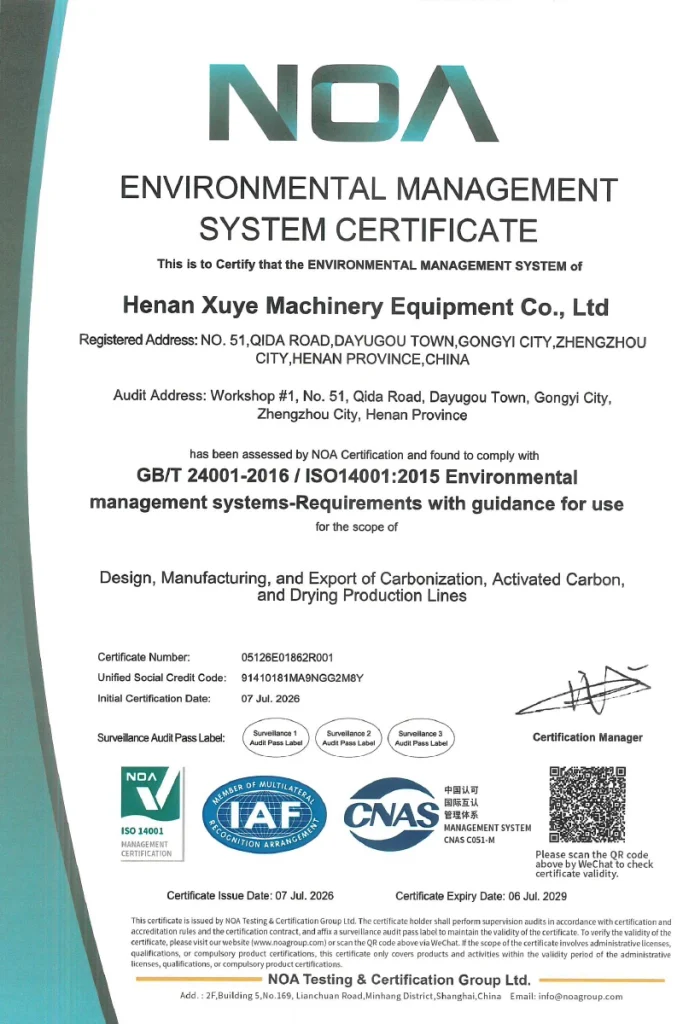
ISO Environmental Management Certificate
FAQ
Frequently Asked Questions About Activated Carbon Production Lines
The activation kiln is specially designed for processing almond shells into activated carbon. It can also be adapted to other biomass materials, such as coconut shells, walnut shells, apricot shells, and other suitable carbonized materials.
The production capacity depends on the equipment model, raw material characteristics, activation temperature, and processing time. Xu Ye Machinery can customize equipment according to customers’ production requirements.
Yes. We offer continuous rotary kiln systems designed for stable and efficient industrial production. The continuous feeding and discharging system helps reduce manual operation and improve production efficiency.
Yes. Xu Ye Machinery provides customized solutions based on production capacity, raw materials, factory layout, heating methods, and local operating conditions.
The kiln uses high-temperature activation technology. Carbonized almond shells are heated inside the kiln under controlled conditions, with steam or other suitable activation agents introduced to develop a porous structure and increase the specific surface area of the activated carbon.
Different heating methods can be selected according to project requirements, including direct heating and indirect heating. We can recommend a suitable heating system based on the production process, energy source, and operating conditions.
A carbonization furnace converts almond shells or other biomass materials into charcoal through oxygen-limited heating. An activation kiln further processes the carbonized material using high temperatures and activation agents to develop pores and produce activated carbon.
The final product is almond shell-based activated carbon, which can be processed into granular, powdered, or other specified forms depending on the production process and customer requirements. It can be used in water purification, air purification, and industrial adsorption applications.
