 徐悦設備


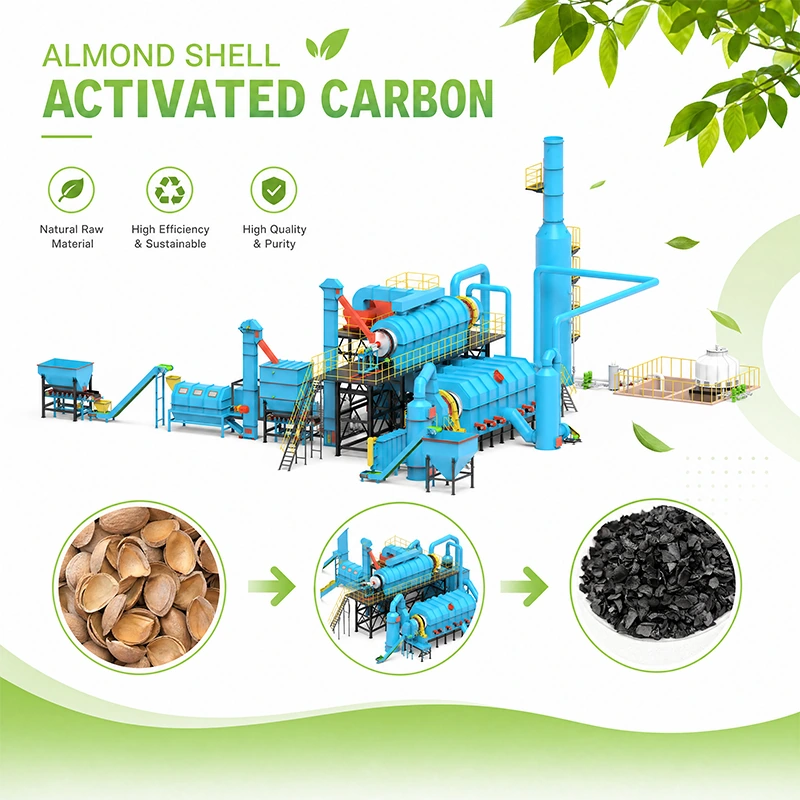
Almond Shell Activated Carbon Making Machine
Almond shells are valuable agricultural by-products that can be utilized as raw materials for activated carbon manufacturing. After the edible almond kernels are removed, the remaining hard shells can be collected, processed, and converted into carbon-rich materials through thermal treatment.
について Almond Shell Activated Carbon Making Machine is designed to process almond shells into activated carbon through a series of operations, including raw material preparation, drying, carbonization, activation, cooling, crushing, screening, and packaging.
Almond shells have a relatively hard structure and contain organic carbon components, making them potential raw materials for producing granular and powdered activated carbon.
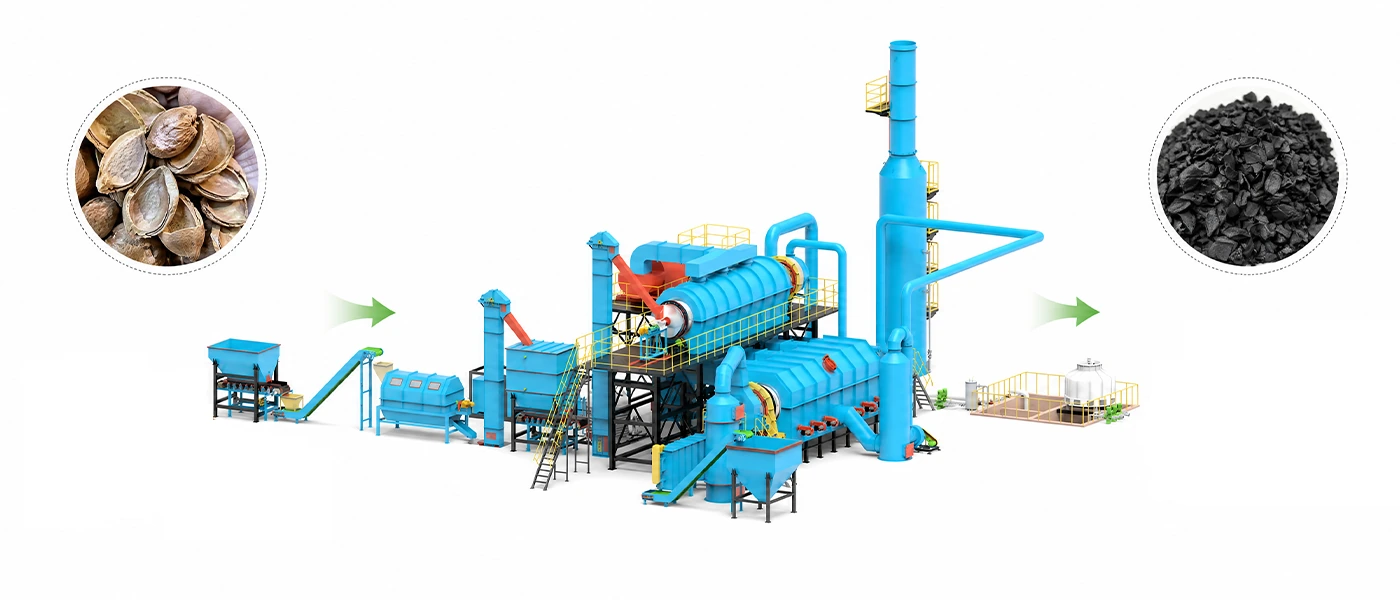
Henan Xuye Machinery Equipment Co., Ltd. provides equipment solutions for almond shell carbonization and activated carbon production. Depending on the customer’s production requirements, the system can include a rotary dryer, carbonization furnace, rotary activation kiln, cooling equipment, crusher, vibrating screen, and auxiliary systems.
Our equipment can also be evaluated for processing other agricultural shell materials, including apricot shells, walnut shells, hazelnut shells, coconut shells, and palm kernel shells.
Whether you are establishing a new almond shell activated carbon plant or upgrading an existing production facility, we can configure suitable equipment according to your raw material characteristics, production capacity, and finished product requirements.
Why Use Almond Shells for Activated Carbon Production?
Almond processing generates considerable quantities of hard outer shells. These shells are often separated from the edible kernels during industrial processing and can be collected for further utilization.
Instead of treating almond shells as agricultural waste, manufacturers can use them as a raw material for carbonization and activated carbon manufacturing.
Hard Shell Structure
Almond shells have a relatively dense and hard structure. After carbonization and activation, the resulting carbon material can be further processed into granular products.
Agricultural By-Product Utilization
Almond shell activated carbon production provides an additional utilization route for materials generated by the almond processing industry.
Potential for Different Activated Carbon Products
Depending on the carbonization and activation conditions, almond shells can be processed into different forms of activated carbon, including granular activated carbon and powdered activated carbon.
Industrial Processing Compatibility
Almond shells can be processed using carbonization furnaces and activation equipment designed for agricultural biomass and other hard-shell materials.
The final product properties depend on the raw material composition, carbonization conditions, activation degree, and subsequent processing operations.
How Does a Date Pits Activated Carbon Production Line Work?
A commercial date seed activated carbon production plant consists of multiple processing sections. The equipment arrangement depends on whether the project uses a continuous or batch production configuration.
The general processing sequence is:
Raw Date Pits → Cleaning → Crushing → Drying → Carbonization → Activation → Cooling → Grinding → Screening → Packaging
Each operation has a specific purpose.
1. Raw Material Cleaning and Preparation
Collected date pits may contain residual fruit pulp, dust, sand, and other foreign materials.
The first stage is designed to remove impurities that could affect subsequent processing or increase the ash content of the finished product.
Depending on the raw material condition, the preparation system may include vibrating screens, magnetic separators, washing equipment, and conveyors.
If washing is required, the seeds need to be dried before carbonization.
2. Date Pits Crushing and Size Control
Date pits are harder than many conventional biomass materials. Therefore, crushing equipment should be selected according to the actual hardness and required particle size.
A suitable crusher reduces the raw material into smaller and more uniform pieces.
The crushing process helps improve:
- Feeding consistency
- Heat transfer during carbonization
- Material movement inside the furnace
- Process stability
- Final product consistency
The appropriate particle size should be determined according to the furnace structure and processing requirements. Excessive crushing is not always necessary, since it can increase dust generation and reduce the efficiency of material handling.
3. Drying Before Carbonization
Moisture content is an important parameter in biomass carbonization.
Excessive moisture increases the energy required for heating and evaporation. Therefore, a drying system is often installed before the carbonization furnace.
An industrial rotary dryer can continuously process prepared date pits by transferring heat to the moving material inside a rotating drum.
The dryer can be configured according to the initial moisture content, required processing capacity, and available heating source.
The target moisture level should be established according to the selected carbonization process.
4. Carbonization of Date Pits
Carbonization is the thermal conversion stage in which prepared date pits are transformed into carbon-rich charcoal.
The material enters a carbonization furnace and is heated under oxygen-limited conditions.
As the temperature increases, several physical and chemical changes take place:
- Residual moisture evaporates.
- Volatile organic compounds are released.
- Biomass components undergo thermal decomposition.
- A solid carbon-rich residue is formed.
- Combustible gases are generated.
A continuous rotary carbonization furnace can be used for industrial processing. The rotating structure helps move materials through the heating chamber while maintaining controlled residence time.
The carbonization temperature, heating rate, and residence time should be established through material testing.
The combustible gases generated during processing can be collected and directed to a combustion chamber. Under a suitable system design, the recovered gas can be burned to provide part of the thermal energy required by the production process.
5. Steam Activation of Carbonized Date Pits
Carbonized date pits are not automatically equivalent to activated carbon. An additional activation process is required to develop the pore structure and adsorption characteristics.
Steam activation is a widely used physical activation method for biomass-derived charcoal.
During this process, carbonized material is heated to an elevated temperature while controlled steam is introduced into the activation furnace.
Steam reacts with carbon through controlled gasification reactions, gradually developing pores within the carbon structure.
The activation process is influenced by:
- Activation temperature
- Steam flow rate
- Residence time
- Carbon particle size
- Carbonization characteristics
- Carbon burn-off rate
Steam activation commonly operates within a high-temperature range of approximately 800–950°C, although actual operating conditions must be determined through process development and testing.
The objective is to develop the required adsorption properties while maintaining an acceptable product yield.
Over-activation can result in excessive carbon consumption and reduced product yield. Insufficient activation may produce carbon with inadequate adsorption performance.
Therefore, activation conditions should be adjusted according to the intended application and target product specifications.
6. Cooling of Activated Carbon
After activation, the finished carbon material remains at a high temperature.
It must be cooled under controlled conditions before grinding, screening, and packaging.
A suitable cooling system helps reduce the product temperature and provides a safer environment for subsequent material handling.
Hot activated carbon should not be exposed carelessly to air because its high reactivity can create oxidation and fire risks.
7. Grinding, Screening, and Product Classification
After cooling, the activated carbon can be processed according to the required particle size.
For powdered activated carbon, grinding equipment reduces the material into fine particles.
For granular activated carbon, crushing and screening systems can be configured to obtain the required particle-size distribution.
Common product forms include:
- Powdered Activated Carbon (PAC)
- Granular Activated Carbon (GAC)
- Coarse Activated Carbon
- Customized Particle-Size Carbon Products
The final product specifications should be established according to the requirements of the target market.
8. Packaging and Storage
The finished activated carbon is transported to a weighing and packaging system.
Depending on customer requirements, packaging equipment can be configured for small bags, industrial bags, or bulk packaging.
Because activated carbon is a porous adsorbent, finished products should be stored in a clean, dry environment to reduce contamination and unwanted moisture absorption.
Almond Shell Activated Carbon Manufacturing Process
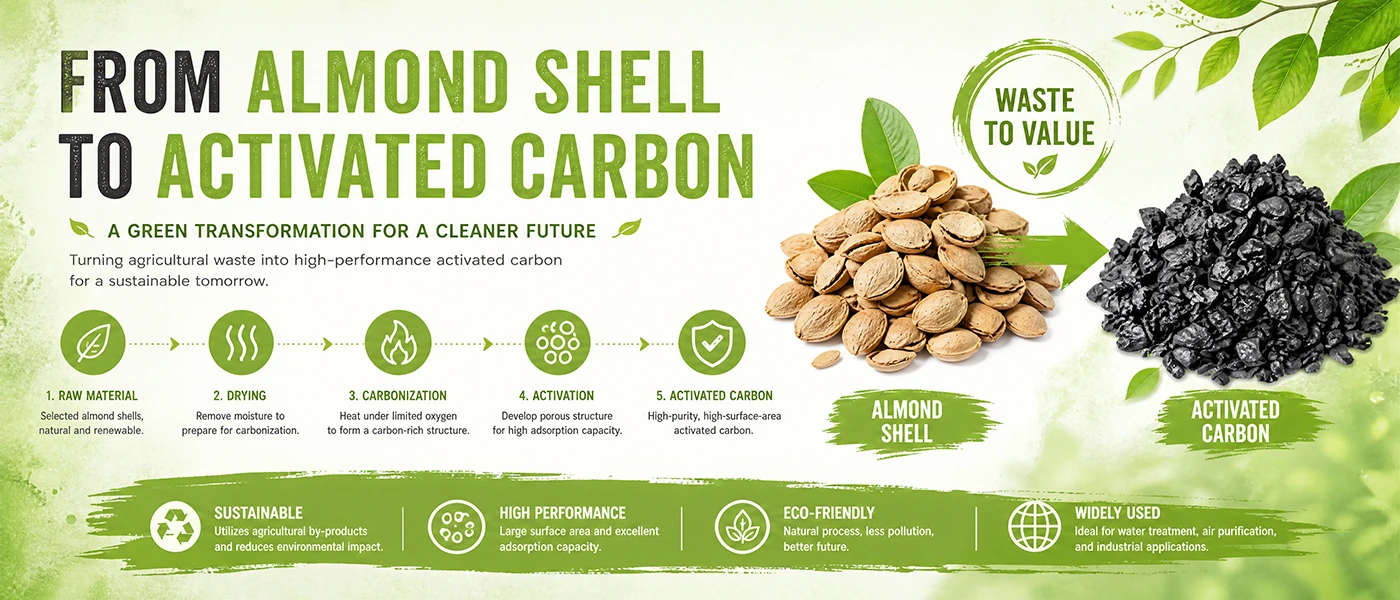
The production of activated carbon from almond shells generally involves several major processing stages.
A typical manufacturing flow is:
Almond Shell Preparation → Drying → Carbonization → Steam Activation → Cooling → Crushing → Screening → Packaging
The process can be customized according to the raw material condition and target activated carbon specifications.
Step 1: Almond Shell Preparation
The collected almond shells are first inspected and cleaned to remove soil, stones, dust, and other foreign materials.
If the shells contain excessive residual organic matter, an additional cleaning process may be required.
The prepared material is then transported to the drying system.
The raw material size should be relatively uniform to facilitate stable feeding and heat transfer during thermal processing.
Step 2: Almond Shell Drying
Moisture content affects the energy consumption and stability of the carbonization process.
When almond shells contain excessive moisture, a drying machine is recommended before carbonization.
A rotary dryer can be used for continuous industrial drying.
The dryer capacity and operating conditions should be selected according to the initial moisture content, material size, and required processing output.
Step 3: Almond Shell Carbonization
Carbonization is a key stage in almond shell activated carbon manufacturing.
The dried almond shells are fed into a carbonization furnace and heated under oxygen-limited conditions.
During heating, organic components undergo thermal decomposition, releasing volatile substances and gradually forming carbon-rich char.
A rotary carbonization furnace can be used for continuous production.
The rotating cylinder allows materials to move through the heating zone while being exposed to controlled thermal conditions.
Important operating parameters include:
- Carbonization temperature.
- Heating rate.
- Material residence time.
- Feeding speed.
- Furnace rotation speed.
- Oxygen control.
The resulting carbonized material is discharged and transported to the activation section.
Step 4: Almond Shell Char Activation
Carbonized almond shells must undergo activation to develop the pore structure required for adsorption applications.
Steam activation is a commonly used physical activation method for agricultural shell-based activated carbon.
During this process, the carbonized material is heated in an activation furnace, and steam is introduced into the reaction zone.
The steam reacts with carbon under controlled high-temperature conditions, gradually developing pores within the carbon structure.
A rotary activation kiln is suitable for continuous industrial processing.
The activation process should be controlled according to the required:
- Iodine adsorption value.
- Specific surface area.
- Pore-size distribution.
- Adsorption capacity.
- Mechanical strength.
- Finished product yield.
Activation temperature, steam flow rate, and residence time all influence the final product properties.
Step 5: Activated Carbon Cooling
After activation, the material is discharged at elevated temperatures.
A cooling machine is installed to reduce the material temperature before crushing and screening.
Proper cooling helps minimize oxidation and reduces the risk of uncontrolled combustion.
The cooling system should be selected according to the activated carbon output and production line configuration.
Step 6: Crushing and Grinding
The cooled almond shell activated carbon enters the crushing or grinding section.
For granular activated carbon, a crusher is used to reduce the material to the required particle size.
For powdered activated carbon, a grinding machine can be installed to produce finer particles.
The selection of equipment depends on the finished product form and particle-size specifications.
Step 7: Screening and Classification
After crushing, activated carbon is transported to a vibrating screening machine.
Different mesh sizes can be used to classify the material into different particle-size ranges.
Qualified products are collected, while oversized particles can be returned for further processing.
Step 8: Finished Product Packaging
The screened activated carbon is transferred to a packaging system.
Automatic weighing and packaging machines can be configured according to customer requirements.
Finished products can be packed in woven bags, jumbo bags, or other suitable industrial packaging.
Rotary Carbonization Furnace for Almond Shells
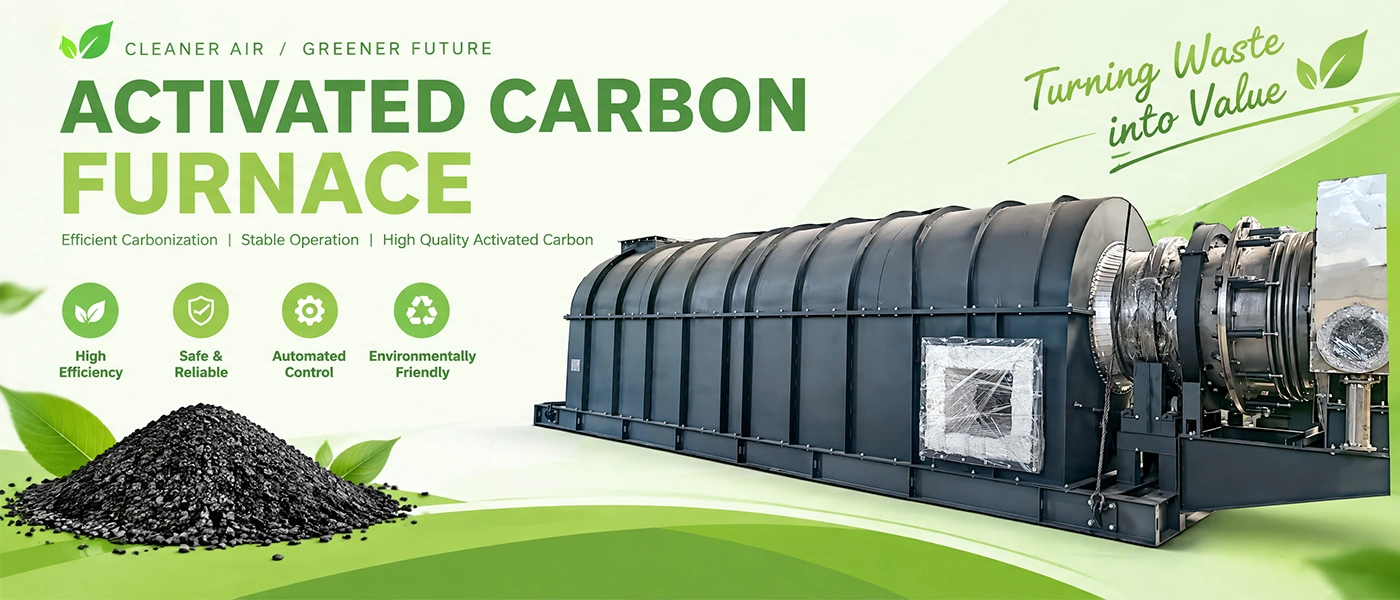
The carbonization furnace is one of the most important machines in almond shell activated carbon production.
Its primary function is to convert almond shells into carbon-rich material through thermal decomposition under oxygen-limited conditions.
For industrial applications, a rotary carbonization furnace is a suitable option for continuous processing.
Continuous Feeding and Discharging
The rotary structure supports continuous material movement through the heating zone, making it suitable for industrial production.
Controlled Carbonization Temperature
Temperature monitoring and control systems help maintain the required thermal conditions.
Adjustable Residence Time
The material residence time can be adjusted through feeding speed, furnace rotation speed, and equipment configuration.
Combustible Gas Collection
During carbonization, volatile gases are generated. Depending on their composition and calorific value, suitable combustible gases can be collected and directed to a combustion chamber for controlled burning.
Production Line Integration
The carbonization furnace can be connected with a dryer, activation kiln, cooling equipment, and material conveying systems.
Almond Shell Activated Carbon Activation Kiln
The activation kiln is designed to transform carbonized almond shells into activated carbon with a developed pore structure.
For continuous production, a rotary activation kiln can be selected.
During steam activation, the carbonized material moves through the heated kiln while steam is introduced into the reaction zone.
The activation process involves a controlled reaction between steam and carbon.
The main operating parameters include:
Activation Temperature
Temperature influences the reaction rate and pore development.
Steam Flow Rate
Steam consumption needs to be adjusted according to material feeding quantity and activation requirements.
Residence Time
The material must remain in the activation zone for an appropriate period to achieve the target activation degree.
Carbon Burn-Off
Activation consumes part of the carbon material. Excessive burn-off can reduce product yield and affect the mechanical strength of activated carbon.
Raw Material Characteristics
The operating parameters should be determined according to the physical and chemical characteristics of the almond shells and the required product specifications.
Applications of Almond Shell Activated Carbon
Activated carbon produced from almond shells can be used in different industrial sectors when its properties meet the required application standards.
Water Purification
Granular activated carbon is used in water treatment systems to adsorb certain organic contaminants and reduce undesirable odors and tastes.
Industrial Wastewater Treatment
Activated carbon can be applied in wastewater treatment systems to remove selected organic compounds and other adsorbable substances.
Air Filtration and Gas Purification
Depending on its pore structure and surface characteristics, almond shell activated carbon can be used in air filtration and gas purification systems.
Chemical Industry
Activated carbon is used in various chemical processing operations for adsorption, separation, and purification.
Industrial Filtration
Granular activated carbon can be incorporated into filtration systems for different industrial applications.
The actual application suitability depends on the finished product’s adsorption performance and quality specifications.
Technical Specifications
| 定員 | 5-8トン/日 | 8-10t/d | 10-12t/d | 12-15t/d | 15-20t/d |
| Dryer model | HG-800 | HG-1000 | HG-1200 | HG-1500 | HG-1800 |
| Dryer power | 3kw | 4kw | 7.5kw | 15kw | 22kw |
| continuous carbonization furnace model | TH-1500 | TH-1500 | TH-1800 | TH-2000 | TH-2000 |
| Carbonization temperature | 600-850℃ | ||||
| Fixed carbon content after carbonization | 70-80% | ||||
| Carbonization furnace drum material | 309S/310S | 309S/310S | 309S/310S | 309S/310S | 309S/310S |
| Activation furnace model | HN-5 | HN-8 | HN-10 | HN-12 | HN-15 |
| Activation furnace power | 15kw | 22kw | 30kw | 37kw | 37kw |
| Activation furnace chamber material | QQ345+nano thermal insulation board+refractory | ||||
| Activation temperature | 850-950℃ | ||||
| アクティベーター | Water vapor or Phosphoric acid (customized according to customer requirements, equipment design will be updated) | ||||
| Activation time | 1-2h | ||||
| Cooling machine model | GTL-1004 | GTL-1204 | GTL-1206 | GTL-1504 | GTL-1506 |
| Temperature after cooling | ≤40℃ | ||||
| Activated carbon crusher model | SGP-400 | SGP-400 | SGP-600 | SGP-800 | SGP-800 |
| Activated carbon finished product size | 4-60mesh | ||||
| Activated carbon iodine value | 800-1300mg/g | ||||
| Activated carbon specific surface area | 800-1500m²/g | ||||
| Activated carbon strength | ≥95 | ||||
| CTC | ≥60% | ||||
| Filling density | 0.45-0.55g/cm3 | ||||
| Activated carbon ash | ≤3% | ||||
Certificate
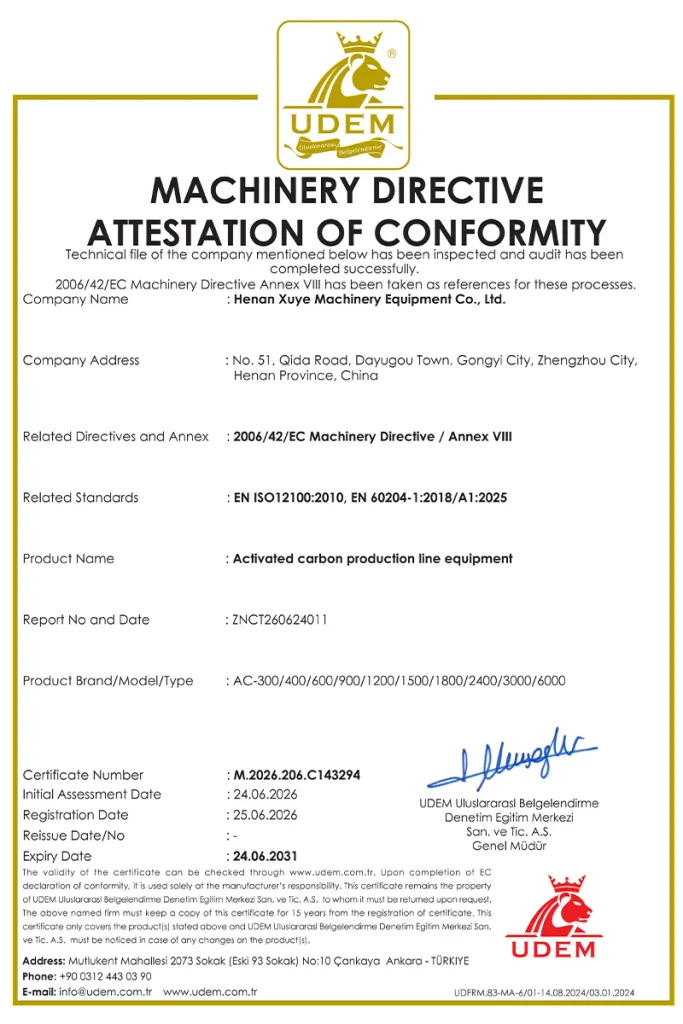
CE Certificate
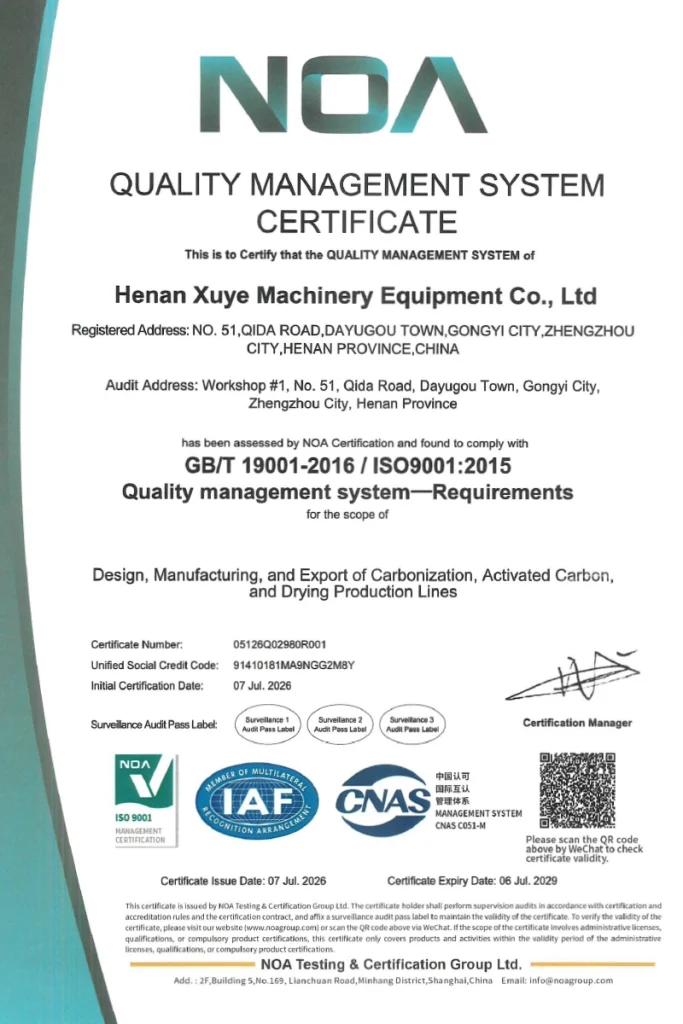
ISO Quality Management Certificate
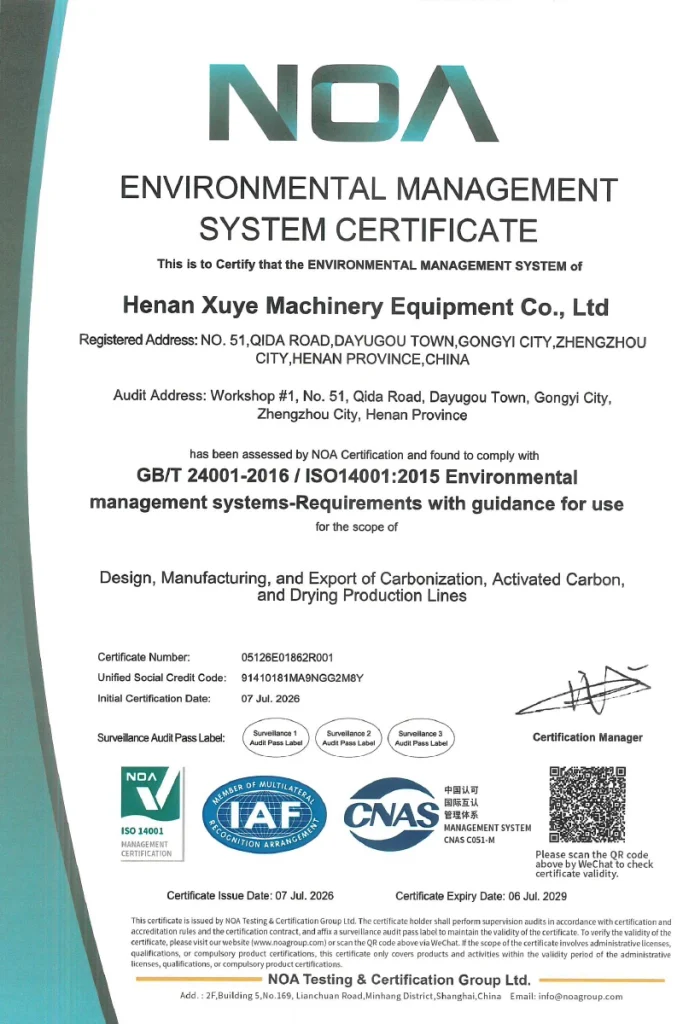
ISO Environmental Management Certificate
FAQ
Frequently Asked Questions About Activated Carbon Production Lines
The activation kiln is specially designed for processing almond shells into activated carbon. It can also be adapted to other biomass materials, such as coconut shells, walnut shells, apricot shells, and other suitable carbonized materials.
The production capacity depends on the equipment model, raw material characteristics, activation temperature, and processing time. Xu Ye Machinery can customize equipment according to customers’ production requirements.
Yes. We offer continuous rotary kiln systems designed for stable and efficient industrial production. The continuous feeding and discharging system helps reduce manual operation and improve production efficiency.
Yes. Xu Ye Machinery provides customized solutions based on production capacity, raw materials, factory layout, heating methods, and local operating conditions.
The kiln uses high-temperature activation technology. Carbonized almond shells are heated inside the kiln under controlled conditions, with steam or other suitable activation agents introduced to develop a porous structure and increase the specific surface area of the activated carbon.
Different heating methods can be selected according to project requirements, including direct heating and indirect heating. We can recommend a suitable heating system based on the production process, energy source, and operating conditions.
A carbonization furnace converts almond shells or other biomass materials into charcoal through oxygen-limited heating. An activation kiln further processes the carbonized material using high temperatures and activation agents to develop pores and produce activated carbon.
The final product is almond shell-based activated carbon, which can be processed into granular, powdered, or other specified forms depending on the production process and customer requirements. It can be used in water purification, air purification, and industrial adsorption applications.
